


Page 351 - Applied Process Design For Chemical And Petrochemical Plants Volume III
P. 351
66131_Ludwig_CH11A  5/30/2001 4:49 PM  Page 308


                       308                       Applied Process Design for Chemical and Petrochemical Plants

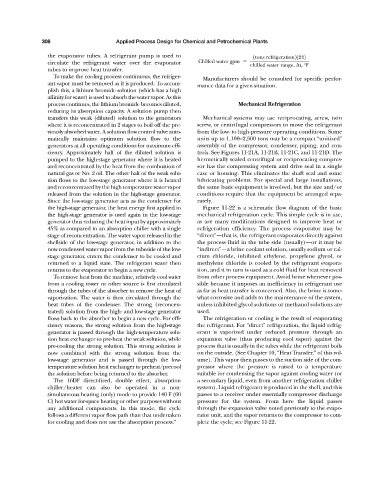
                         the evaporator tubes. A refrigerant pump is used to                     1tons refrigeration21242
                         circulate the refrigerant water over the evaporator  Chilled water gpm
                                                                                               chilled water range,  t, °F
                         tubes to improve heat transfer.
                           To make the cooling process continuous, the refriger-
                                                                               Manufacturers should be consulted for specific perfor-
                         ant vapor must be removed as it is produced. To accom-
                                                                             mance data for a given situation.
                         plish this, a lithium bromide solution (which has a high
                         affinity for water) is used to absorb the water vapor. As this
                         process continues, the lithium bromide becomes diluted,           Mechanical Refrigeration
                         reducing its absorption capacity. A solution pump then
                         transfers this weak (diluted) solution to the generators  Mechanical systems may use reciprocating, screw, twin
                         where it is reconcentrated in 2 stages to boil off the pre-  screw, or centrifugal compressors to move the refrigerant
                         viously absorbed water. A solution flow control valve auto-  from the low- to high-pressure operating conditions. Some
                         matically maintains optimum solution flow to the    units up to 1,100—2,500 tons may be a compact “unitized”
                         generators at all operating conditions for maximum effi-  assembly of the compressor, condenser, piping, and con-
                         ciency. Approximately half of the diluted solution is  trols. See Figures 11-21A, 11-21B, 11-21C, and 11-21D. The
                         pumped to the high-stage generator where it is heated  hermetically sealed centrifugal or reciprocating compres-
                         and reconcentrated by the heat from the combustion of  sor has the compressing system and drive seal in a single
                         natural gas or No. 2 oil. The other half of the weak solu-  case or housing. This eliminates the shaft seal and some
                         tion flows to the low-stage generator where it is heated  lubricating problems. For special and large installations,
                         and reconcentrated by the high temperature water vapor  the same basic equipment is involved, but the size and/or
                         released from the solution in the high-stage generator.  conditions require that the equipment be arranged sepa-
                         Since the low-stage generator acts as the condenser for  rately.
                         the high-stage generator, the heat energy first applied in  Figure 11-22 is a schematic flow diagram of the basic
                         the high-stage generator is used again in the low-stage  mechanical refrigeration cycle. This simple cycle is in use,
                         generator thus reducing the heat input by approximately  as are many modifications designed to improve heat or
                         45% as compared to an absorption chiller with a single  refrigeration efficiency. The process evaporator may be
                         stage of reconcentration. The water vapor released in the  “direct”—that is, the refrigerant evaporates directly against
                         shellside of the low-stage generator, in addition to the  the process fluid in the tube side (usually)—or it may be
                         now condensed water vapor from the tubeside of the low-  “indirect”—a brine coolant solution, usually sodium or cal-
                         stage generator, enters the condenser to be cooled and  cium chloride, inhibited ethylene, propylene glycol, or
                         returned to a liquid state. The refrigerant water then  methylene chloride is cooled by the refrigerant evapora-
                         returns to the evaporator to begin a new cycle.     tion, and it in turn is used as a cold fluid for heat removed
                           To remove heat from the machine, relatively cool water  from other process equipment. Avoid brine whenever pos-
                         from a cooling tower or other source is first circulated  sible because it imposes an inefficiency in refrigerant use
                         through the tubes of the absorber to remove the heat of  as far as heat transfer is concerned. Also, the brine is some-
                         vaporization. The water is then circulated through the  what corrosive and adds to the maintenance of the system,
                         heat tubes of the condenser. The strong (reconcen-  unless inhibited glycol solutions or methanol solutions are
                         trated) solution from the high- and low-stage generator  used.
                         flows back to the absorber to begin a new cycle. For effi-  The refrigeration or cooling is the result of evaporating
                         ciency reasons, the strong solution from the high-stage  the refrigerant. For “direct” refrigeration, the liquid refrig-
                         generator is passed through the high-temperature solu-  erant is vaporized under reduced pressure through an
                         tion heat exchanger to pre-heat the weak solution, while  expansion valve (thus producing cool vapor) against the
                         pre-cooling the strong solution. This strong solution is  process that is usually in the tubes while the refrigerant boils
                         now combined with the strong solution from the      on the outside. (See Chapter 10, “Heat Transfer,” of this vol-
                         low-stage generator and is passed through the low-  ume). This vapor then passes to the suction side of the com-
                         temperature solution heat exchanger to preheat/precool  pressor where the pressure is raised to a temperature
                         the solution before being returned to the absorber.  suitable for condensing the vapor against cooling water (or
                           The 16DF direct-fired, double effect, absorption  a secondary liquid, even from another refrigeration chiller
                         chiller/heater can also be operated in a non-       system). Liquid refrigerant is produced in the shell, and this
                         simultaneous heating (only) mode to provide 140 F (60  passes to a receiver under essentially compressor discharge
                         C) hot water for-space heating or other purposes without  pressure for the system. From here the liquid passes
                         any additional components. In this mode, the cycle  through the expansion valve noted previously to the evapo-
                         follows a different vapor flow path than that undertaken  rator unit, and the vapor returns to the compressor to com-
                         for cooling and does not use the absorption process.”  plete the cycle; see Figure 11-22.

