


Page 348 - Applied Process Design For Chemical And Petrochemical Plants Volume III
P. 348
66131_Ludwig_CH11A  5/30/2001 4:49 PM  Page 305


                                                                Refrigeration Systems                                      305

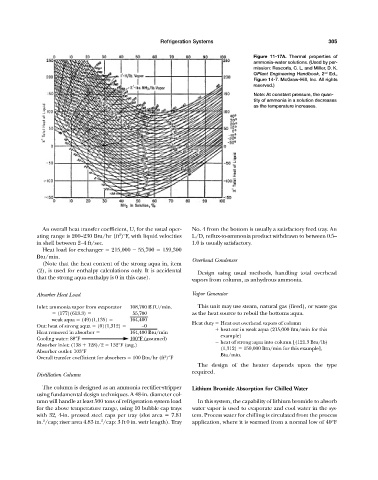
                                                                                                 Figure 11-17A.  Thermal properties of
                                                                                                 ammonia-water solutions. (Used by per-
                                                                                                 mission: Rescorla, C. L. and Miller, D. K.
                                                                                                 ©Plant Engineering Handbook, 2 nd  Ed.,
                                                                                                 Figure 14-7. McGraw-Hill, Inc. All rights
                                                                                                 reserved.)
                                                                                                 Note: At constant pressure, the quan-
                                                                                                 tity of ammonia in a solution decreases
                                                                                                 as the temperature increases.


                       An overall heat transfer coefficient, U, for the usual oper-  No. 4 from the bottom is usually a satisfactory feed tray. An
                                                  2
                     ating range is 200—230 Btu/hr (ft )°F, with liquid velocities  L/D, reflux-to-ammonia product withdrawn to between 0.5—
                     in shell between 2—4 ft/sec.                          1.0 is usually satisfactory.
                       Heat load for exchanger   215,000   55,700   159,300
                     Btu/min.
                                                                           Overhead Condenser
                       (Note that the heat content of the strong aqua in, item
                     (2), is used for enthalpy calculations only. It is accidental
                                                                             Design using usual methods, handling total overhead
                     that the strong aqua enthalpy is 0 in this case).
                                                                           vapors from column, as anhydrous ammonia.
                     Absorber Heat Load                                    Vapor Generator

                     Inlet: ammonia vapor from evaporator   108,700 BTU/min.  This unit may use steam, natural gas (fired), or waste gas
                            (177)(613.3)              055,700              as the heat source to reboil the bottoms aqua.
                          weak aqua   (49)(1,135)     164,400
                     Out: heat of strong aqua   (0)(1,312)    –0           Heat duty   Heat out overhead vapors of column
                     Heat removed in absorber         164,400 Btu/min                heat out in weak aqua (215,000 Btu/min for this
                                                                                     example)
                     Cooling water: 88°F                                 100°F (assumed)
                                                                                     heat of strong aqua into column [(121.3 Btu/lb)
                     Absorber inlet: (138   128)/2   132°F (avg.)
                                                                                     (1,312)   159,000 Btu/min for this example],
                     Absorber outlet: 103°F
                                                                  2
                     Overall transfer coefficient for absorbers   100 Btu/hr (ft )°F    Btu/min.
                                                                             The design of the heater depends upon the type
                                                                           required.
                     Distillation Column
                       The column is designed as an ammonia rectifier-stripper  Lithium Bromide Absorption for Chilled Water
                     using fundamental design techniques. A 48-in. diameter col-
                     umn will handle at least 500 tons of refrigeration system load  In this system, the capability of lithium bromide to absorb
                     for the above temperature range, using 10 bubble cap trays  water vapor is used to evaporate and cool water in the sys-
                     with 32, 4-in. pressed steel caps per tray (slot area   7.81  tem. Process water for chilling is circulated from the process
                       2
                                            2
                     in. /cap; riser area 4.83 in. /cap: 3 ft 0 in. weir length). Tray  application, where it is warmed from a normal low of 40°F

