


Page 345 - Applied Process Design For Chemical And Petrochemical Plants Volume III
P. 345
66131_Ludwig_CH11A  5/30/2001 4:49 PM  Page 303


                                                                Refrigeration Systems                                      303

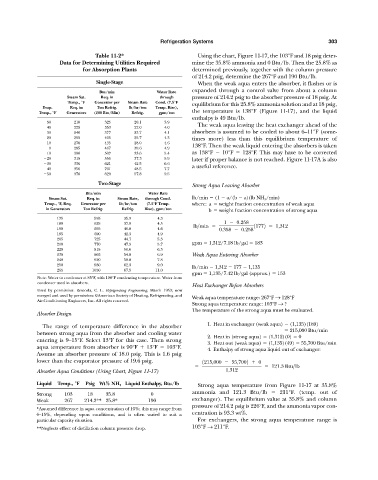
                                          Table 11-2*                        Using the chart, Figure 11-17, the 103°F and 18 psig deter-
                             Data for Determining Utilities Required       mine the 35.8% ammonia and 0 Btu/lb. Then the 25.8% as
                                     for Absorption Plants                 determined previously, together with the column pressure
                                                                           of 214.2 psig, determine the 267°F and 190 Btu/lb.
                                          Single-Stage                       When the weak aqua enters the absorber, it flashes or is
                                                                           expanded through a control valve from about a column
                                           Btu/min             Water Rate
                                Steam Sat.   Req. in            through    pressure of 214.2 psig to the absorber pressure of 18 psig. At
                                Temp., °F   Generator per  Steam Rate   Cond. (7.5°F  equilibrium for this 25.8% ammonia solution and at 18 psig,
                       Evap.     Req. in   Ton Refrig.   lb/hr/ton   Temp. Rise),
                      Temp., °F  Generators  (200 Btu/Min)  Refrig.  gpm/ton  the temperature is 138°F (Figure 11-17), and the liquid
                                                                           enthalpy is 49 Btu/lb.
                         50       210        325       20.1       3.9
                         40       225        353       22.0       4.0        The weak aqua leaving the heat exchanger ahead of the
                         30       240        377       23.7       4.1      absorbers is assumed to be cooled to about 6—11°F (some-
                         20       255        405       25.7       4.3      times more) less than this equilibrium temperature of
                         10       270        435       28.0       4.6
                         0        285        467       30.6       4.9      138°F. Then the weak liquid entering the absorbers is taken
                         10       300        507       33.6       5.4      as 138°F   10°F   128°F. This may have to be corrected
                         20       315        555       37.3       5.9      later if proper balance is not reached. Figure 11-17A is also
                         30       330        621       42.5       6.6
                         40       350        701       48.5       7.7      a useful reference.
                         50       370        820       57.8       9.5
                                           Two-Stage
                                                                           Strong Aqua Leaving Absorber
                                      Btu/min               Water Rate
                         Steam Sat.    Req. in   Steam Rate,   through Cond.   lb/min   (1   a/(b   a)(lb NH 3 /min)
                        Temp., °F, Req.   Generator per   lb/hr/ton   (7.5°F Temp.   where: a   weight fraction concentration of weak aqua
                        in Generators  Ton Refrig.  Refrig.  Rise), gpm/ton      b   weight fraction concentration of strong aqua
                            175          595        35.9       4.3
                            180          625        37.8       4.5                    1     0.258
                            190          655        40.0       4.6          lb>min      0.358     0.258 11772     1,312
                            195          690        42.3       4.9
                            205          725        44.7       5.3
                            210          770        47.5       5.7         gpm   1,312/7.18 lb/gal   183
                            220          815        50.6       6.3
                            230          865        54.0       6.9         Weak Aqua Entering Absorber
                            240          920        58.0       7.8
                            250          980        62.3       9.0         lb/min   1,312   177   1,135
                            265         1050        67.5      11.0
                                                                           gpm   1,135/7.42 lb/gal (approx.)   153
                     Note: Water to condenser at 85°F, with 100°F condensing temperature. Water from
                     condenser used in absorbers.
                                                                           Heat Exchanger Before Absorbers
                     Used by permission: Rescorla, C. L.  Refrigerating Engineering, March 1953; now
                     merged and used by permission: ©American Society of Heating, Refrigerating, and  Weak aqua temperature range: 267°F S 128°F
                     Air-Conditioning Engineers, Inc. All rights reserved.
                                                                           Strong aqua temperature range: 103°F S ?
                                                                           The temperature of the strong aqua must be evaluated.
                     Absorber Design
                                                                                 1. Heat in exchanger (weak aqua)   (1,135)(189)
                       The range of temperature difference in the absorber
                                                                                                             215,000 Btu/min
                     between strong aqua from the absorber and cooling water
                                                                                 2. Heat in (strong aqua)   (1,312)(0)   0
                     entering is 9—15°F. Select 13°F for this case. Then strong
                                                                                 3. Heat out (weak aqua)   (1,135)(49)   55,700 Btu/min
                     aqua temperature from absorber is 90°F   13°F   103°F.      4. Enthalpy of strong aqua liquid out of exchanger:
                     Assume an absorber pressure of 18.0 psig. This is 1.6 psig
                     lower than the evaporator pressure of 19.6 psig.          1215,000     55,7002     0
                                                                                                        121.3 Btu>lb
                     Absorber Aqua Conditions (Using Chart, Figure 11-17)              1,312
                     Liquid  Temp., °F  Psig Wt% NH 3 Liquid Enthalpy, Btu/lb  Strong aqua temperature from Figure 11-17 at 35.8%
                                                                           ammonia and 121.3 Btu/lb    211°F. (temp. out of
                     Strong    103     18    35.8            0
                     Weak      267  00214.2** *25.8*        190            exchanger). The equilibrium value at 35.8% and column
                                                                           pressure of 214.2 psig is 226°F, and the ammonia vapor con-
                     *Assumed difference in aqua concentration of 10%; this may range from
                                                                           centration is 93.3 wt%.
                     6—15%, depending upon conditions, and is often varied to suit a
                     particular capacity situation.                          For exchangers, the strong aqua temperature range is
                                                                           103°F S 211°F.
                     **Neglects effect of distillation column pressure drop.

