


Page 349 - Applied Process Design For Chemical And Petrochemical Plants Volume III
P. 349
66131_Ludwig_CH11A  5/30/2001 4:49 PM  Page 306


                       306                       Applied Process Design for Chemical and Petrochemical Plants


                                                        Water Vapor boil off


                                                          Liquid level                                       Cooling Water


                       Heat Source                                    Condenser
                       (Steam, Nat,
                       gas, etc).      Generator

                                                        Strong (conc)                           Refrigerant
                                                             Li Br sol'n                        Liquid


                                                             Refrigerant
                                                             Vapor to be absorbed

                                                                                                         To Process Use for
                                                                                                                          Chilled water
                                                               Cooling water
                                                               from Cooling Tower
                                                                                                       Recirculating
                                                                or other source
                                                                                                       Refrigerant Pump
                                               Weak LiBr Pump
                                                                                   Evaporator
                                             Absorber                              (Under vacuum, at boil
                                                                                   point water at 40°F±)

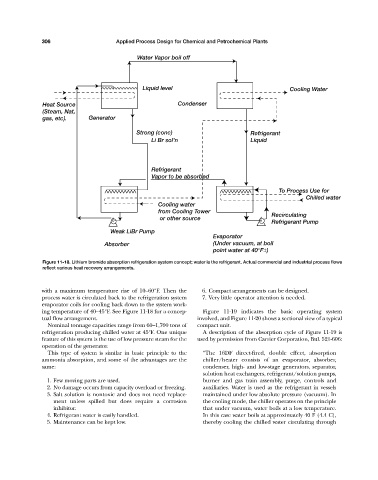
                       Figure 11-18. Lithium bromide absorption refrigeration system concept; water is the refrigerant. Actual commercial and industrial process flows
                       reflect various heat recovery arrangements.


                       with a maximum temperature rise of 10—60°F. Then the    6. Compact arrangements can be designed.
                       process water is circulated back to the refrigeration system  7. Very little operator attention is needed.
                       evaporator coils for cooling back down to the system work-
                       ing temperature of 40—45°F. See Figure 11-18 for a concep-  Figure 11-19 indicates the basic operating system
                       tual flow arrangement.                                involved, and Figure 11-20 shows a sectional view of a typical
                         Nominal tonnage capacities range from 60—1,700 tons of  compact unit.
                       refrigeration producing chilled water at 45°F. One unique  A description of the absorption cycle of Figure 11-19 is
                       feature of this system is the use of low pressure steam for the  used by permission from Carrier Corporation, Bul. 521-606:
                       operation of the generator.
                         This type of system is similar in basic principle to the  “The 16DF direct-fired, double effect, absorption
                       ammonia absorption, and some of the advantages are the  chiller/heater consists of an evaporator, absorber,
                       same:                                                   condenser, high- and low-stage generators, separator,
                                                                               solution heat exchangers, refrigerant/solution pumps,
                         1. Few moving parts are used.                         burner and gas train assembly, purge, controls and
                         2. No damage occurs from capacity overload or freezing.  auxiliaries. Water is used as the refrigerant in vessels
                         3. Salt solution is nontoxic and does not need replace-  maintained under low absolute pressure (vacuum). In
                           ment unless spilled but does require a corrosion    the cooling mode, the chiller operates on the principle
                           inhibitor.                                          that under vacuum, water boils at a low temperature.
                         4. Refrigerant water is easily handled.               In this case water boils at approximately 40 F (4.4 C),
                         5. Maintenance can be kept low.                       thereby cooling the chilled water circulating through

