


Page 461 - Applied Numerical Methods Using MATLAB
P. 461
450    PARTIAL DIFFERENTIAL EQUATIONS
                        2
                       ∂ u(x, t)  ∂u(x, t)
                     −5
               (b) 10          =            for 0 ≤ x ≤ 1, 0 ≤ t ≤ 6000  (P9.4.3)
                         ∂x 2       ∂t
                  with the initial/boundary conditions
                      u(x, 0) = 2x + sin(2πx),  u(0,t) = 0,  u(1,t) = 2  (P9.4.4)

                   (i) With the solution region divided into M × N = 20 × 40 sections,
                      does the explicit forward Euler method converge? What is the value
                                      2
                      of r = A t/( x) ? Does the numerical stability condition (9.2.6)
                      seem to be so demanding?
                   (ii) If you increase M and N to make M × N = 40 × 160 for better
                      accuracy, does the explicit forward Euler method still converge?
                                                     2
                      What is the value of r = A t/( x) ? Does the numerical stability
                      condition (9.2.6) seem to be so demanding?
                  (iii) With the solution region divided into M × N = 40 × 200 sections,
                      does the explicit forward Euler method converge? What is the value
                                      2
                      of r = A t/( x) ?
                     2
                    ∂ u(x, t)  ∂u(x, t)
               (c) 2        =            for 0 ≤ x ≤ π, 0 ≤ t ≤ 0.2     (P9.4.5)
                      ∂x 2       ∂t
                  with the initial/boundary conditions

                       u(x, 0) = sin(2x),  u(0,t) = 0,   u(π, t) = 0    (P9.4.6)

                   (i) By substituting
                                          u(x, t) = sin(2x)e −8t        (P9.4.7)

                      into the above equation (P9.4.5), verify that this is a solution to
                      the PDE.
                   (ii) With the solution region divided into M × N = 40 × 100 sections,
                      does the explicit forward Euler method converge? What is the value
                                      2
                      of r = A t/( x) ?
                  (iii) If you increase N (the number of subintervals along the t-axis) to
                      125 for improving the numerical stability, does the explicit forward
                                                                         2
                      Euler method converge? What is the value of r = A t/( x) ?Use
                      the MATLAB statements in the following box to find the maximum
                      absolute errors of the numerical solutions obtained by the three
                      methods. Which method yields the smallest error?


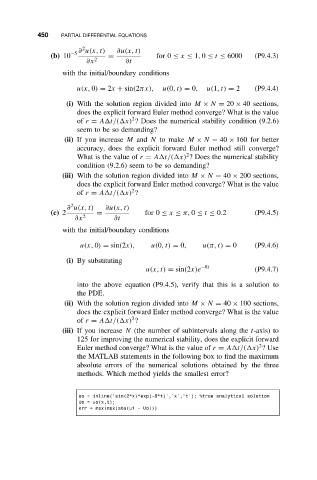
                       uo = inline(’sin(2*x)*exp(-8*t)’,’x’,’t’); %true analytical solution
                       Uo = uo(x,t);
                       err = max(max(abs(u1 - Uo)))

