


Page 465 - Applied Numerical Methods Using MATLAB
P. 465
454    PARTIAL DIFFERENTIAL EQUATIONS
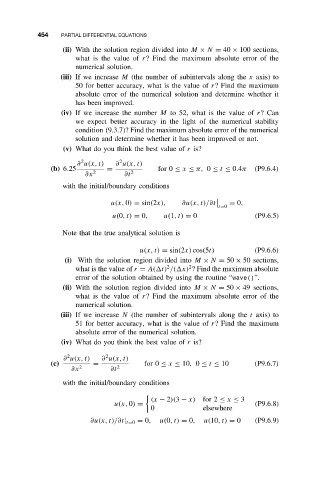
                  (ii) With the solution region divided into M × N = 40 × 100 sections,
                      what is the value of r? Find the maximum absolute error of the
                      numerical solution.
                  (iii) If we increase M (the number of subintervals along the x axis) to
                      50 for better accuracy, what is the value of r? Find the maximum
                      absolute error of the numerical solution and determine whether it
                      has been improved.
                  (iv) If we increase the number M to 52, what is the value of r?Can
                      we expect better accuracy in the light of the numerical stability
                      condition (9.3.7)? Find the maximum absolute error of the numerical
                      solution and determine whether it has been improved or not.
                   (v) What do you think the best value of r is?

                                  2
                        2
                      ∂ u(x, t)  ∂ u(x, t)
               (b) 6.25        =             for 0 ≤ x ≤ π, 0 ≤ t ≤ 0.4π  (P9.6.4)
                         ∂x 2       ∂t 2
                  with the initial/boundary conditions

                                u(x, 0) = sin(2x),  ∂u(x, t)/∂t     = 0,
                                                              t=0
                                u(0,t) = 0,   u(1,t) = 0                (P9.6.5)

                  Note that the true analytical solution is

                                        u(x, t) = sin(2x) cos(5t)       (P9.6.6)
                   (i) With the solution region divided into M × N = 50 × 50 sections,
                                               2
                                                     2
                      what is the value of r = A( t) /( x) ? Find the maximum absolute
                      error of the solution obtained by using the routine “wave()”.
                  (ii) With the solution region divided into M × N = 50 × 49 sections,
                      what is the value of r? Find the maximum absolute error of the
                      numerical solution.
                  (iii) If we increase N (the number of subintervals along the t axis) to
                      51 for better accuracy, what is the value of r? Find the maximum
                      absolute error of the numerical solution.
                  (iv) What do you think the best value of r is?

                    2
                              2
                   ∂ u(x, t)  ∂ u(x, t)
               (c)         =             for 0 ≤ x ≤ 10, 0 ≤ t ≤ 10     (P9.6.7)
                     ∂x 2       ∂t 2
                  with the initial/boundary conditions

                                           (x − 2)(3 − x)  for 2 ≤ x ≤ 3
                                 u(x, 0) =                              (P9.6.8)
                                           0             elsewhere
                          ∂u(x, t)/∂t| t=0 = 0,  u(0,t) = 0,  u(10,t) = 0  (P9.6.9)

