


Page 467 - Applied Numerical Methods Using MATLAB
P. 467
456    PARTIAL DIFFERENTIAL EQUATIONS
           9.8 PDEtool: GUI (Graphical User Interface) of MATLAB for Solving PDEs
               (a) Consider the PDE
                     2
                                            2
                                 2
                    ∂ u(x, y)   ∂ u(x, y)  ∂ u(x, y)
                   4         − 4         +         = 0   for 0 ≤ x ≤ 1, 0 ≤ y ≤ 1
                       ∂x 2       ∂x∂y       ∂y 2
                                                                        (P9.8.1)
                  with the boundary conditions
                                     2y
                          u(0,y) = ye ,     u(1,y) = (1 + y)e 1+2y ,
                                                                        (P9.8.2)
                                     x
                          u(x, 0) = xe ,   u(x, 1) = (x + 1)e x+2
                  Noting that the field of coefficient c should be filled in as

                         	   Elliptic       c  4-2-21        4-21

                  in the PDE specification dialog box and the true analytical solution is
                                       u(x, y) = (x + y)e x+2y          (P9.8.3)

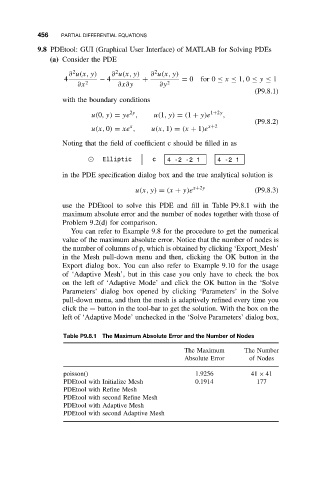
                  use the PDEtool to solve this PDE and fill in Table P9.8.1 with the
                  maximum absolute error and the number of nodes together with those of
                  Problem 9.2(d) for comparison.
                     You can refer to Example 9.8 for the procedure to get the numerical
                  value of the maximum absolute error. Notice that the number of nodes is
                  the number of columns of p, which is obtained by clicking ‘Export Mesh’
                  in the Mesh pull-down menu and then, clicking the OK button in the
                  Export dialog box. You can also refer to Example 9.10 for the usage
                  of ‘Adaptive Mesh’, but in this case you only have to check the box
                  on the left of ‘Adaptive Mode’ and click the OK button in the ‘Solve
                  Parameters’ dialog box opened by clicking ‘Parameters’ in the Solve
                  pull-down menu, and then the mesh is adaptively refined every time you
                  click the = button in the tool-bar to get the solution. With the box on the
                  left of ‘Adaptive Mode’ unchecked in the ‘Solve Parameters’ dialog box,


                   Table P9.8.1 The Maximum Absolute Error and the Number of Nodes
                                                    The Maximum      The Number
                                                    Absolute Error    of Nodes
                   poisson()                           1.9256          41 × 41
                   PDEtool with Initialize Mesh        0.1914           177
                   PDEtool with Refine Mesh
                   PDEtool with second Refine Mesh
                   PDEtool with Adaptive Mesh
                   PDEtool with second Adaptive Mesh

