


Page 205 - Applied Probability
P. 205
9. Descent Graph Methods
                              190
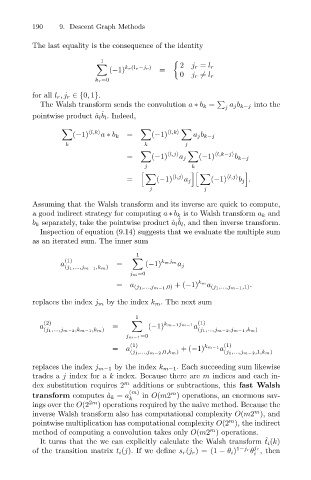
                              The last equality is the consequence of the identity

                                                                     0 j r  = l r
                                               k r =0
                              for all l r ,j r ∈{0, 1}. 1  (−1) k r (l r −j r )  =  ,  2 j r = l r

                                The Walsh transform sends the convolution a ∗ b k =  a j b k−j into the
                                                                                 j
                                                ˆ
                              pointwise product ˆ a l b l . Indeed,

                                         (−1)  l,k   a ∗ b k  =  (−1)  l,k   a j b k−j
                                       k                    k         j

                                                       =      (−1)  l,j   a j  (−1)  l,k−j   b k−j
                                                            j           k


                                                       =       (−1)  l,j  a j  (−1)  l,j  b j .
                                                             j             j
                              Assuming that the Walsh transform and its inverse are quick to compute,
                              a good indirect strategy for computing a ∗ b k is to Walsh transform a k and
                                                                    ˆ
                              b k separately, take the pointwise product ˆ a l b l , and then inverse transform.
                                Inspection of equation (9.14) suggests that we evaluate the multiple sum
                              as an iterated sum. The inner sum
                                                          1
                                       (1)
                                      a             =       (−1) k m j m  a j
                                       (j 1 ,...,j m−1 ,k m )
                                                        j m =0
                                                    = a (j 1 ,...,j m−1 ,0) +(−1) k m a (j 1 ,...,j m−1 ,1) .
                              replaces the index j m by the index k m . The next sum
                                                         1
                                 (2)                    	                 (1)
                                a                  =         (−1) k m−1 j m−1  a
                                 (j 1 ,...,j m−2 ,k m−1 ,k m )            (j 1 ,...,j m−2 ,j m−1 ,k m )
                                                       j m−1 =0
                                                        (1)                     (1)
                                                   = a               +(−1) k m−1 a
                                                        (j 1 ,...,j m−2 ,0,k m )  (j 1 ,...,j m−2 ,1,k m )
                              replaces the index j m−1 by the index k m−1 . Each succeeding sum likewise
                              trades a j index for a k index. Because there are m indices and each in-
                              dex substitution requires 2 m  additions or subtractions, this fast Walsh
                                                        (m)        m
                              transform computes ˆ a k = a k  in O(m2 ) operations, an enormous sav-
                              ings over the O(2 2m ) operations required by the naive method. Because the
                                                                                        m
                              inverse Walsh transform also has computational complexity O(m2 ), and
                                                                                  m
                              pointwise multiplication has computational complexity O(2 ), the indirect
                                                                             m
                              method of computing a convolution takes only O(m2 ) operations.
                                It turns that the we can explicitly calculate the Walsh transform ˆ t i (k)
                                                                                        j r
                              of the transition matrix t i (j). If we define s r (j r )=(1 − θ i ) 1−j r θ , then
                                                                                        i

