


Page 379 - Applied Statistics And Probability For Engineers
P. 379
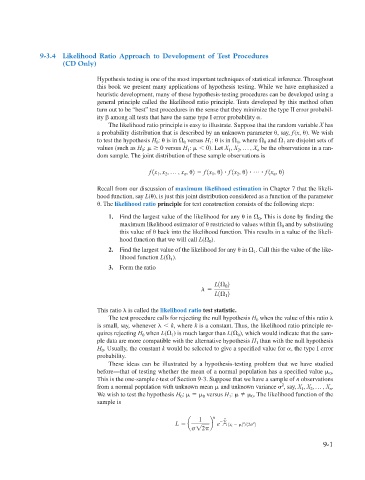
PQ220 6234F.CD(09)  5/15/02  8:21 PM  Page 1 RK UL 6 RK UL 6:Desktop Folder:TEMP WORK:MONTGOMERY:REVISES UPLO D CH114 FIN L:Quark F


                 9-3.4 Likelihood Ratio Approach to Development of Test Procedures
                        (CD Only)

                                   Hypothesis testing is one of the most important techniques of statistical inference. Throughout
                                   this book we present many applications of hypothesis testing. While we have emphasized a
                                   heuristic development, many of these hypothesis-testing procedures can be developed using a
                                   general principle called the likelihood ratio principle. Tests developed by this method often
                                   turn out to be “best” test procedures in the sense that they minimize the type II error probabil-
                                   ity   among all tests that have the same type I error probability  .
                                       The likelihood ratio principle is easy to illustrate. Suppose that the random variable X has
                                   a probability distribution that is described by an unknown parameter  , say, f(x,  ). We wish
                                   to test the hypothesis H :   is in   versus H :   is in   , where   and   are disjoint sets of
                                                              0
                                                                               1
                                                                       1
                                                                                              1
                                                                                        0
                                                      0
                                   values (such as H :    0 versus H :     0). Let X , X , p , X be the observations in a ran-
                                                                                      n
                                                 0
                                                                             1
                                                                1
                                                                                2
                                   dom sample. The joint distribution of these sample observations is
                                                    f  1x , x , p , x ,  2   f  1x ,  2   f 1x ,  2    p    f  1x ,  2
                                                               n
                                                         2
                                                                               2
                                                                                           n
                                                      1
                                                                       1
                                   Recall from our discussion of maximum likelihood estimation in Chapter 7 that the likeli-
                                   hood function, say L( ), is just this joint distribution considered as a function of the parameter
                                    . The likelihood ratio principle for test construction consists of the following steps:
                                       1.  Find the largest value of the likelihood for any   in   . This is done by finding the
                                                                                      0
                                          maximum likelihood estimator of   restricted to values within   and by substituting
                                                                                             0
                                          this value of   back into the likelihood function. This results in a value of the likeli-
                                          hood function that we will call L(  ).
                                                                       0
                                       2.  Find the largest value of the likelihood for any   in   . Call this the value of the like-
                                                                                     1
                                          lihood function L(  ).
                                                          1
                                       3.  Form the ratio
                                                                        L1  0 2

                                                                        L1  2
                                                                            1
                                   This ratio 	 is called the likelihood ratio test statistic.
                                                                                      when the value of this ratio
                                       The test procedure calls for rejecting the null hypothesis H 0
                                   is small, say, whenever 	   k, where k is a constant. Thus, the likelihood ratio principle re-
                                   quires rejecting H when L(  ) is much larger than L(  ), which would indicate that the sam-
                                                           1
                                                                                0
                                                 0
                                   ple data are more compatible with the alternative hypothesis H than with the null hypothesis
                                                                                     1
                                   H . Usually, the constant k would be selected to give a specified value for  , the type I error
                                     0
                                   probability.
                                       These ideas can be illustrated by a hypothesis-testing problem that we have studied
                                   before—that of testing whether the mean of a normal population has a specified value   .
                                                                                                            0
                                   This is the one-sample t-test of Section 9-3. Suppose that we have a sample of n observations
                                                                                             2
                                   from a normal population with unknown mean   and unknown variance
 , say, X 1 , X 2 , p , X n .
                                   We wish to test the hypothesis H 0 :     0 versus H 1 :     0 . The likelihood function of the
                                   sample is
                                                                   1    n
g n
                                                                                 2
                                                            L   a      b  e  i 1 1x i
 2  12
 2 2

12
                                                                                                          9-1

