


Page 381 - Applied Statistics And Probability For Engineers
P. 381
PQ220 6234F.CD(09)  5/15/02  8:21 PM  Page 3 RK UL 6 RK UL 6:Desktop Folder:TEMP WORK:MONTGOMERY:REVISES UPLO D CH114 FIN L:Quark F


                                                                                                          9-3


                                                     2
                                              1x
  2
                                                    0
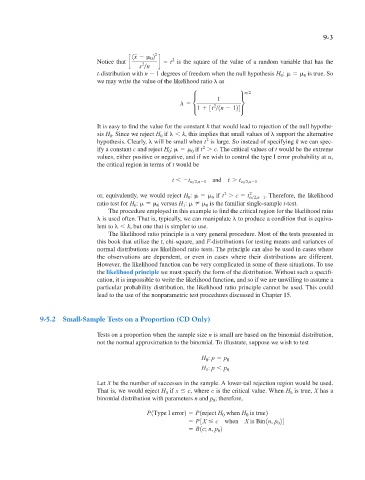
                                   Notice that  c  2  d   t 2  is the square of the value of a random variable that has the
                                                 s  n
                                   t-distribution with n
 1 degrees of freedom when the null hypothesis H :     is true. So
                                                                                             0
                                                                                                    0
                                   we may write the value of the likelihood ratio 	 as
                                                                                  n  2
                                                                         1
                                                                 c      2        s
                                                                   1   3t  1n
 124
                                   It is easy to find the value for the constant k that would lead to rejection of the null hypothe-
                                   sis H . Since we reject H if 	  k, this implies that small values of 	 support the alternative
                                       0
                                                       0
                                                                      2
                                   hypothesis. Clearly, 	 will be small when t is large. So instead of specifying k we can spec-
                                                                     2
                                   ify a constant c and reject H :     if t   c. The critical values of t would be the extreme
                                                          0
                                                                 0
                                   values, either positive or negative, and if we wish to control the type I error probability at  ,
                                   the critical region in terms of t would be
                                                           t
t    2,n
1   and  t   t    2,n
1
                                                                           2
                                   or, equivalently, we would reject H :     if t   c   t 2    2,n
1 . Therefore, the likelihood
                                                                       0
                                                                0
                                   ratio test for H :     versus H :     is the familiar single-sample t-test.
                                                      0
                                                              1
                                                                      0
                                               0
                                       The procedure employed in this example to find the critical region for the likelihood ratio
                                   	 is used often. That is, typically, we can manipulate 	 to produce a condition that is equiva-
                                   lent to 	  k, but one that is simpler to use.
                                       The likelihood ratio principle is a very general procedure. Most of the tests presented in
                                   this book that utilize the t, chi-square, and F-distributions for testing means and variances of
                                   normal distributions are likelihood ratio tests. The principle can also be used in cases where
                                   the observations are dependent, or even in cases where their distributions are different.
                                   However, the likelihood function can be very complicated in some of these situations. To use
                                   the likelihood principle we must specify the form of the distribution. Without such a specifi-
                                   cation, it is impossible to write the likelihood function, and so if we are unwilling to assume a
                                   particular probability distribution, the likelihood ratio principle cannot be used. This could
                                   lead to the use of the nonparametric test procedures discussed in Chapter 15.


                 9-5.2  Small-Sample Tests on a Proportion (CD Only)


                                   Tests on a proportion when the sample size n is small are based on the binomial distribution,
                                   not the normal approximation to the binomial. To illustrate, suppose we wish to test


                                                                    H 0 : p   p 0
                                                                    H : p   p 0
                                                                      1
                                   Let X be the number of successes in the sample. A lower-tail rejection region would be used.
                                   That is, we would reject H if x   c, where c is the critical value. When H is true, X has a
                                                                                                0
                                                         0
                                   binomial distribution with parameters n and p ; therefore,
                                                                        0
                                                   P 1Type I error2   P 1reject H 0  when H 0  is true2
                                                                  P 3X   c  when  X is Bin 1n, p 0 24
                                                                  B 1c; n, p 0 2

