


Page 387 - Applied Statistics And Probability For Engineers
P. 387
c10.qxd  5/17/02  1:58 PM  Page 331 RK UL 6 RK UL 6:Desktop Folder:TEMP WORK:MONTGOMERY:REVISES UPLO D CH114 FIN L:Quark Files:


                       10-2 INFERENCE FOR A DIFFERENCE IN MEANS OF TWO NORMAL DISTRIBUTIONS, VARIANCES KNOWN  331


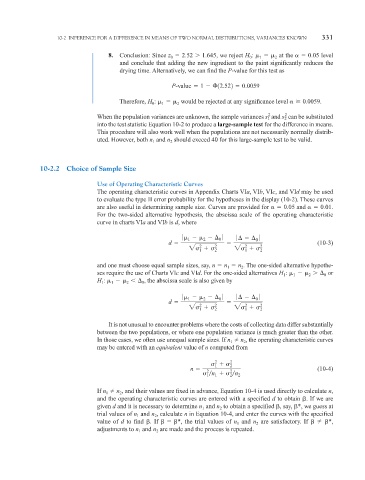
                                       8.  Conclusion: Since z 0   2.52   1.645, we reject H 0 :   1    2 at the    0.05 level
                                          and conclude that adding the new ingredient to the paint significantly reduces the
                                          drying time. Alternatively, we can find the P-value for this test as

                                                           P-value   1    12.522   0.0059

                                          Therefore, H 0 :   1    2 would be rejected at any significance level    0.0059.
                                                                                              2
                                                                                         2
                                   When the population variances are unknown, the sample variances  and  can be substituted
                                                                                        s 1
                                                                                             s 2
                                   into the test statistic Equation 10-2 to produce a large-sample test for the difference in means.
                                   This procedure will also work well when the populations are not necessarily normally distrib-
                                   uted. However, both n 1 and n 2 should exceed 40 for this large-sample test to be valid.


                 10-2.2   Choice of Sample Size

                                   Use of Operating Characteristic Curves
                                   The operating characteristic curves in Appendix Charts VIa, VIb, VIc, and VId may be used
                                   to evaluate the type II error probability for the hypotheses in the display (10-2). These curves
                                   are also useful in determining sample size. Curves are provided for    0.05 and    0.01.
                                   For the two-sided alternative hypothesis, the abscissa scale of the operating characteristic
                                   curve in charts VIa and VIb is d, where

                                                              ƒ        ƒ       ƒ     ƒ
                                                                     2
                                                                          0
                                                                1
                                                                                     0
                                                          d                                              (10-3)
                                                                   2    2         2    2
                                                                2  1
  2     2  1
  2
                                   and one must choose equal sample sizes, say, n   n 1   n 2 . The one-sided alternative hypothe-
                                   ses require the use of Charts VIc and VId. For the one-sided alternatives H 1 :   1    2    0 or
                                   H 1 :   1    2 	  0 , the abscissa scale is also given by
                                                              ƒ        ƒ       ƒ     ƒ
                                                                                     0
                                                                          0
                                                                     2
                                                                1
                                                          d
                                                                   2
                                                                                  2
                                                                2
    2 2   2
     2 2
                                                                                  1
                                                                   1
                                       It is not unusual to encounter problems where the costs of collecting data differ substantially
                                   between the two populations, or where one population variance is much greater than the other.
                                   In those cases, we often use unequal sample sizes. If n
 n , the operating characteristic curves
                                                                                 2
                                                                             1
                                   may be entered with an equivalent value of n computed from
                                                                        2    2
                                                                         1
  2
                                                                 n    2      2                           (10-4)
                                                                       1 n
  2 n 2
                                                                        1
                                   If n 1
 n 2 , and their values are fixed in advance, Equation 10-4 is used directly to calculate n,
                                   and the operating characteristic curves are entered with a specified d to obtain  . If we are
                                   given d and it is necessary to determine n 1 and n 2 to obtain a specified  , say,  *, we guess at
                                   trial values of n 1 and n 2 , calculate n in Equation 10-4, and enter the curves with the specified
                                   value of d to find  . If    *, the trial values of n 1 and n 2 are satisfactory. If
 *,
                                   adjustments to n 1 and n 2 are made and the process is repeated.

