


Page 391 - Applied Statistics And Probability For Engineers
P. 391
c10.qxd  5/16/02  1:30 PM  Page 335 RK UL 6 RK UL 6:Desktop Folder:TEMP WORK:MONTGOMERY:REVISES UPLO D CH114 FIN L:Quark Files:


                       10-2 INFERENCE FOR A DIFFERENCE IN MEANS OF TWO NORMAL DISTRIBUTIONS, VARIANCES KNOWN  335


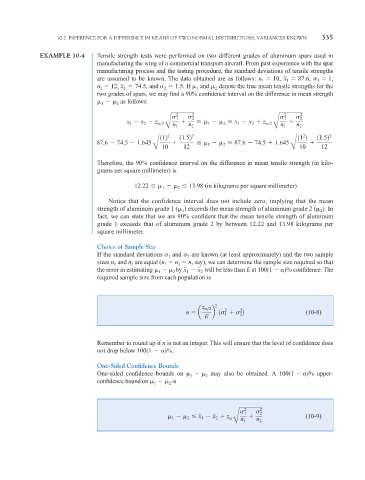
                 EXAMPLE 10-4      Tensile strength tests were performed on two different grades of aluminum spars used in
                                   manufacturing the wing of a commercial transport aircraft. From past experience with the spar
                                   manufacturing process and the testing procedure, the standard deviations of tensile strengths
                                   are assumed to be known. The data obtained are as follows: n   10,  x 1    87.6,     1,
                                                                                       1
                                                                                                         1
                                   n   12, x 2    74.5, and     1.5. If   and   denote the true mean tensile strengths for the
                                                                        2
                                                                   1
                                    2
                                                        2
                                   two grades of spars, we may find a 90% confidence interval on the difference in mean strength
                                        as follows:
                                     1
                                         2
                                                            2    2                            2    2
                                                             1    2                            1    2
                                             x   x   z
 2  ˛              x   x   z
 2  ˛
                                                                               1
                                                                           2
                                             1
                                                                                    2
                                                  2
                                                                      1
                                                           n
                                                                                             n
                                                         B 1    n 2                        B 1    n 2
                                                                                                    2
                                                       112 2  11.52 3                             11 2   11.52 2
                                                                          87.6   74.5   1.645
                                                     B 10     12                                B 10      12
                                   87.6   74.5   1.645 ˛              1    2
                                   Therefore, the 90% confidence interval on the difference in mean tensile strength (in kilo-
                                   grams per square millimeter) is
                                               12.22         13.98   (in kilograms per square millimeter)
                                                             2
                                                        1
                                       Notice that the confidence interval does not include zero, implying that the mean
                                   strength of aluminum grade 1 (  ) exceeds the mean strength of aluminum grade 2 (  2 ). In
                                                              1
                                   fact, we can state that we are 90% confident that the mean tensile strength of aluminum
                                   grade 1 exceeds that of aluminum grade 2 by between 12.22 and 13.98 kilograms per
                                   square millimeter.
                                   Choice of Sample Size
                                   If the standard deviations   1 and   2 are known (at least approximately) and the two sample
                                   sizes n 1 and n 2 are equal (n 1   n 2   n, say), we can determine the sample size required so that
                                   the error in estimating   1     2  by x   x 2  will be less than E at 100(1    )% confidence. The
                                                               1
                                   required sample size from each population is
                                                                        2
                                                                    z
 2  2   2
                                                               n   a   b  1  1    2 2                (10-8)
                                                                     E

                                   Remember to round up if n is not an integer. This will ensure that the level of confidence does
                                   not drop below 100(1   )%.

                                   One-Sided Confidence Bounds
                                   One-sided confidence bounds on       may also be obtained.  A 100(1   )% upper-
                                                                 1
                                                                     2
                                   confidence bound on      is
                                                     1
                                                          2
                                                                                  2    2
                                                                                  1    2
                                                           1
                                                              2   x 1   x 2   z       n     n        (10-9)
                                                                              B 1     2

