


Page 131 - Applied statistics and probability for engineers
P. 131
Section 4-2/Probability Distributions and Probability Density Functions      109

                                            Similarly, a probability density function  f x ( )  can be used to describe the probability
                                         distribution of a continuous random variable X. If an interval is likely to contain a value for X,
                                         its probability is large and it corresponds to large values for  f x ( ). The probability that X is
                                         between a and b is determined as the integral of f x ( ) from a to b. See Fig. 4-2.

                        Probability Density
                                Function     For a continuous random variable X, a probability density function is a function
                                             such that
                                               (1)  f x ( ) ≥ 0
                                                   ∞
                                               (2)   ∫  f x dx = 1
                                                     (
                                                       )
                                                  −∞
                                                                 ( )
                                               (3) (    X ≤  b) =  b ∫  f x dx = area under  f x ( ) from a  to b for any a and b  (4-1)
                                                  P a ≤
                                                               a
                                            A probability density function provides a simple description of the probabilities associated
                                         with a random variable. As long as f x ( ) is nonnegative and   −∞ ∫ ∞  f x ( ) = 1 , 0 ≤ (a ,  X ,  b ) ≤  1
                                                                                                     P
                                         so that the probabilities are properly restricted. A probability density function is zero for x
                                         values that cannot occur, and it is assumed to be zero wherever it is not speciically deined.
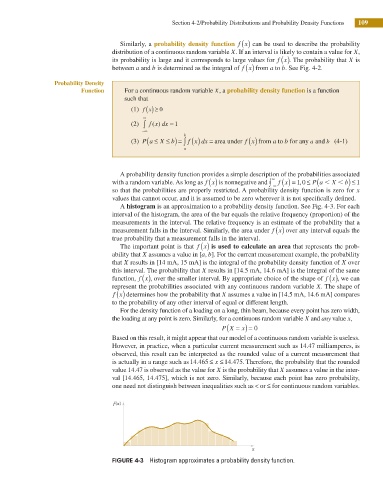
                                            A histogram is an approximation to a probability density function. See Fig. 4-3. For each
                                         interval of the histogram, the area of the bar equals the relative frequency (proportion) of the
                                         measurements in the interval. The relative frequency is an estimate of the probability that a
                                         measurement falls in the interval. Similarly, the area under  f x ( ) over any interval equals the
                                         true probability that a measurement falls in the interval.
                                            The important point is that f x ( ) is used to calculate an area  that represents the prob-
                                         ability that X assumes a value in [a, b]. For the current measurement example, the probability
                                         that X results in [14 mA, 15 mA] is the integral of the probability density function of X over
                                         this interval. The probability that X results in [14.5 mA, 14.6 mA] is the integral of the same
                                         function,  f x ( ), over the smaller interval. By appropriate choice of the shape of  f x ( ), we can
                                         represent the probabilities associated with any continuous random variable X. The shape of
                                         f x ( ) determines how the probability that X assumes a value in [14.5 mA, 14.6 mA] compares
                                         to the probability of any other interval of equal or different length.
                                            For the density function of a loading on a long, thin beam, because every point has zero width,
                                         the loading at any point is zero. Similarly, for a continuous random variable X and any value x,
                                                                            (
                                                                           P X =  x) = 0
                                         Based on this result, it might appear that our model of a continuous random variable is useless.
                                         However, in practice, when a particular current measurement such as 14.47 milliamperes, is
                                         observed, this result can be interpreted as the rounded value of a current measurement that
                                         is actually in a range such as 14 465 ≤ ≤  14 475. Therefore, the probability that the rounded
                                                                   .
                                                                             .
                                                                        x
                                         value 14.47 is observed as the value for X is the probability that X assumes a value in the inter-
                                         val [14.465, 14.475], which is not zero. Similarly, because each point has zero probability,
                                         one need not distinguish between inequalities such as < or ≤ for continuous random variables.
                                          f(x)


                                                                                    x
                                         FIGURE 4-3  Histogram approximates a probability density function.

