


Page 704 - Automotive Engineering Powertrain Chassis System and Vehicle Body
P. 704
Interior noise: Assessment and control    C HAPTER 21.1

             The effect of parameters s, r, h is to lower the speed of              Airborne
           sound within the material (compared with the speed of                   propagation
           sound in free space) and to attenuate the acoustic wave as  Noise                          Receiver
           it propagates. Therefore,                            Source            Structure-borne
                                                                                   propagation
                         e
             pðx; tÞ¼ Ae iut  gx                 (21.1.104)                   (Flanking transmission)
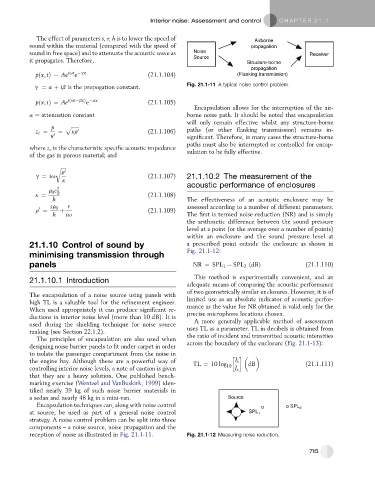
            g ¼ a þ ib is the propogation constant.           Fig. 21.1-11 A typical noise control problem.

                             e
             pðx; tÞ¼ Ae iðut bxÞ  ax            (21.1.105)
                                                                Encapsulation allows for the interruption of the air-
           a ¼ attenuation constant                           borne noise path. It should be noted that encapsulation
                                                              will only remain effective whilst any structure-borne
                  p   p ffiffiffiffiffiffi
             z c ¼  ¼   kr 0                     (21.1.106)   paths (or other flanking transmission) remains in-
                  u 0                                         significant. Therefore, in many cases the structure-borne
                                                              paths must also be interrupted or controlled for encap-
           where z c is the characteristic specific acoustic impedance
           of the gas in porous material; and                 sulation to be fully effective.
                   r ffiffiffiffi
                     r 0
             g ¼ iu                              (21.1.107)   21.1.10.2 The measurement of the
                     k
                                                              acoustic performance of enclosures
                 r c 2
                  0 0
             k ¼                                 (21.1.108)
                  h                                           The effectiveness of an acoustic enclosure may be
                 sr 0  r                                      assessed according to a number of different parameters.
              0
             r ¼     þ                           (21.1.109)
                  h    iu                                     The first is termed noise reduction (NR) and is simply
                                                              the arithmetic difference between the sound pressure
                                                              level at a point (or the average over a number of points)
                                                              within an enclosure and the sound pressure level at
           21.1.10 Control of sound by                        a prescribed point outside the enclosure as shown in
                                                              Fig. 21.1-12:
           minimising transmission through
           panels                                               NR ¼ SPL 1   SPL 2 ðdBÞ              (21.1.110)

                                                                This method is experimentally convenient, and an
           21.1.10.1 Introduction
                                                              adequate means of comparing the acoustic performance
                                                              of two geometrically similar enclosures. However, it is of
           The encapsulation of a noise source using panels with
           high TL is a valuable tool for the refinement engineer.  limited use as an absolute indicator of acoustic perfor-
           When used appropriately it can produce significant re-  mance as the value for NR obtained is valid only for the
           ductions in interior noise level (more than 10 dB). It is  precise microphone locations chosen.
           used during the shielding technique for noise source  A more generally applicable method of assessment
           ranking (see Section 22.1.2).                      uses TL as a parameter. TL in decibels is obtained from
             The principles of encapsulation are also used when  the ratio of incident and transmitted acoustic intensities
           designing noise barrier panels to fit under carpet in order  across the boundary of the enclosure (Fig. 21.1-13):
           to isolate the passenger compartment from the noise in
           the engine bay. Although these are a powerful way of  TL ¼ 10 log  I i  dB                (21.1.111)
           controlling interior noise levels, a note of caution is given   10  I t
           that they are a heavy solution. One published bench-
           marking exercise (Wentzel and VanBuskirk, 1999) iden-
           tified nearly 39 kg of such noise barrier materials in
           a sedan and nearly 48 kg in a mini-van.                         Source
             Encapsulation techniques can, along with noise control                             SPL 2
           at source, be used as part of a general noise control                  SPL 1
           strategy. A noise control problem can be split into three
           components – a noise source, noise propagation and the
           reception of noise as illustrated in Fig. 21.1-11.  Fig. 21.1-12 Measuring noise reduction.


                                                                                                      715

