


Page 316 - Battery Reference Book
P. 316
Lithium alloy thermal batteries  27/13


                                                      Connecting
                                                      lead
                                                      pellet  -Q7/D
                                                      Pyrotechnic


                                                      Cathode  -


                                                      Anode


                                                                           Y
                                                                       Cell assembly
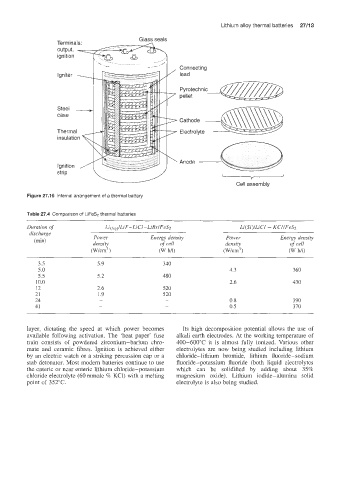
         Figure 27.16  internal arrangement of a thermal battery

         Table 27.4  Comparison of LiFeS? thermal batteries
         Duration of            Li(llqjLzF-LiCl -LiBr/FeSz              Li(Si)lLiCl - KCllFeS2
          discharge          Power            Energy density        Power           Energy density
           (min)             density             of cell            density            of  cell
                            (W/cm3)             (W w               (Wicm3)             (W w
            3.5               5.9                340
            5.0                                                      4.3                360
            5.5               5.2                480
            10.0                                                     2.6                430
            12                2.6                520
            21                1.9                520
            24                                                       0.8                390
            41                                                       0.5                370


         layer,  dictating  the  speed  at  which  power  becomes   Its  high  decomposition  potential  allows  the  use  of
         available  following  activation.  The  'heat  paper'  fuse   alkali earth electrodes. At the working temperature  of
         train  consists  of  powdered  zirconium-barium  chro-   400-600°C  it  is  almost  fully  ionized.  Various  other
         mate  and  ceramic  fibres.  Ignition  is  achieved  either   electrolytes  are  now  being  studied  including  lithium
         by an electric watch  or a striking percussion  cap or a   chloride-lithium  bromide,  lithium  fluoride- sodium
         stab detonator.  Most modern batteries  continue to use   fluoride-potassium  fluoride  (both  liquid  electrolytes
         the enteric or near enteric lithium chloride-potassium   which  can  be  solidified  by  adding  about  35%
         chloride electrolyte (60 mmole % KC1) with a melting   magnesium  oxide).  Lithium  iodide-alumina  solid
         point of  352°C.                            electrolyte is also being  studied.

