


Page 201 - Bebop to The Boolean Boogie An Unconventional Guide to Electronics Fundamentals, Components, and Processes
P. 201
182     Chapter Sixteen

             Generic PLD Structures
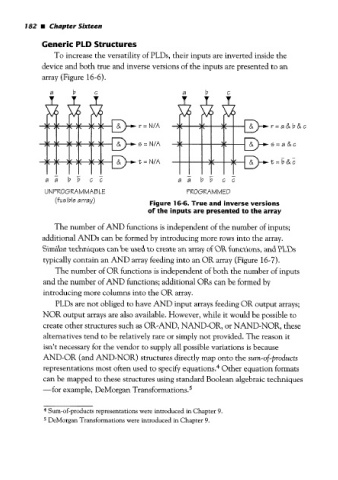
                 To increase the versatility of PLDs, their inputs are inverted inside the
             device and both true and inverse versions of the inputs are presented to an
             array (Figure 16-6).

                a     b      c                         a     b      c


                                          r = NIA                                r=a&b&c


                                          5 = NIA                                s=a&c

                                          t = N/A                                t=L&G

                  I
               I  -   I  I  I  I                        -
              aa  bb  c       c                      aa  bb  c       c
              UNPfZOGfZAMMABLE                          PROGRAMMED
                 (fusible array)             Figure 16-6. True and inverse versions
                                             of the inputs are presented to the array

                 The number of AND functions is independent of the number of inputs;
             additional ANDs can be formed by introducing more rows into the array.
             Similar techniques can be used to create an array of OR functions, and PLDs
              typically contain an AND array feeding into an OR array (Figure 16-7).
                 The number of OR functions is independent of both the number of inputs
              and the number of AND functions; additional ORs can be formed by
              introducing more columns into the OR array.
                 PLDs are not obliged to have AND input arrays feeding OR output arrays;
             NOR output arrays are also available. However, while it would be possible to
              create other structures such as OR-AND, NAND-OR, or NAND-NOR, these
              alternatives tend to be relatively rare or simply not provided. The reason it
              isn’t necessary for the vendor to supply all possible variations is because
              AND-OR (and AND-NOR) structures directly map onto the sum-of-products
              representations most often used to specify  equation^.^ Other equation formats
              can be mapped to these structures using standard Boolean algebraic techniques
              -for  example, DeMorgan Tran~formations.~


              4 Sum-of-products representations were introduced in Chapter 9.
              5 DeMorgan Transformations were introduced in Chapter 9.

