


Page 198 - Bebop to The Boolean Boogie An Unconventional Guide to Electronics Fundamentals, Components, and Processes
P. 198
Programmable Ks        179


            if input a is connected to VDD (logic I), diode D,  will conduct and y will be
            pulled up to logic 1;  similarly for input b and diode D,.  Once again, additional
            inputs can be formed by adding more diodes.

            Fusible-link Technologies

                In the most common PLD technology, which is known as fusible-link, each
            diode has an associated link known as a fuse. The designer can individually
            remove unwanted fuses by applying pulses of relatively high voltage and cur-
            rent, in the order of 20 volts and 300 milliamps, respectively, to the device’s
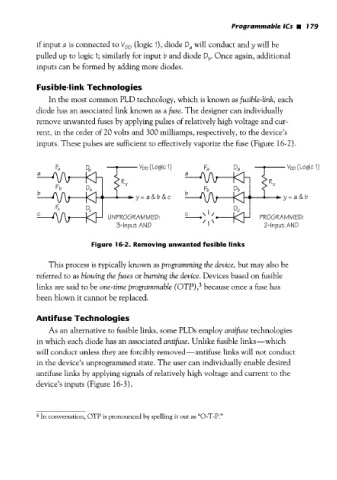
            inputs. These pulses are sufficient to effectively vaporize the fuse (Figure 16-2).


                                 UNPROGRAMMED:                                PROGRAMMED:


                            Figure 16-2. Removing unwanted fusible links


                This process is typically known as programming the device, but may also be
            referred to as blowing the fuses or burning the device. Devices based on fusible
            links are said to be one-time programmable (OTP),3 because once a fuse has
            been blown it cannot be replaced.


            Ant if use Tech nolog ies
                As an alternative to fusible links, some PLDs employ antifuse technologies
            in which each diode has an associated antifuse. Unlike fusible links-which
            will conduct unless they are forcibly removed-antifuse   links will not conduct
            in the device’s unprogrammed state. The user can individually enable desired
            antifuse links by applying signals of relatively high voltage and current to the
            device’s inputs (Figure 16-3 ).


            3 In conversation, OTP is pronounced by spelling it out as “0-T-P.”

