


Page 197 - Bebop to The Boolean Boogie An Unconventional Guide to Electronics Fundamentals, Components, and Processes
P. 197
Programmable ICs


                   Programmable integrated circuits are standard devices constructed in such
                a way that a designer can configure them to perform a specific function. These
                devices, which were introduced in the mid-1970s) are generically known as
                pogrummuble logic devices (PLDs),~,~ and can range in complexity from a few
                hundred to tens of thousands of equivalent gates. Traditional PLDs are based
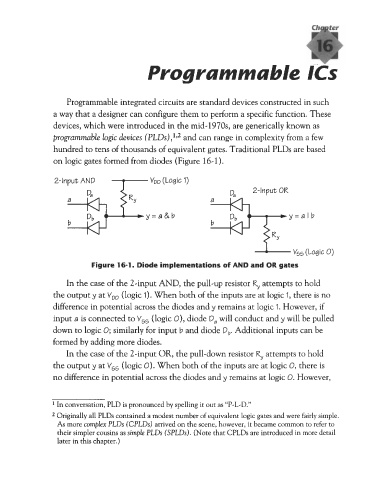
                on logic gates formed from diodes (Figure 16-1).


                2-Input AND               VDD (Logic 1)
                                                                      2-1 n put OR


                    r   b    x   =    a    &    b          r   b    ~   ~  RY  y  =    a    l   b


                                                                                 ~55 (Logic 0)
                          Figure 16-1. Diode implementations of AND and OR gates


                   In the case of the 2-input AND, the pull-up resistor % attempts to hold
                the output y at VDD (logic I).  When both of the inputs are at logic I, there is no
                difference in potential across the diodes and y remains at logic 1.  However, if
                input a is connected to v,,  (logic 0)) diode D,  will conduct and y will be pulled
                down to logic 0; similarly for input b and diode D,.  Additional inputs can be
                formed by adding more diodes.
                   In the case of the 2-input OR, the pull-down resistor % attempts to hold
                the output y at V,,  (logic 0). When both of the inputs are at logic 0, there is
                no difference in potential across the diodes and y remains at logic 0. However,


               1 In conversation, PLD is pronounced by spelling it out as “P-L-D.”
               2 Originally all PLDs contained a modest number of equivalent logic gates and were fairly simple.
                 As more complex PLDs (CPLDs) arrived on the scene, however, it became common to refer to
                 their simpler cousins as simple PLDs (SPLDs). (Note that CPLDs are introduced in more detail
                 later in this chapter.)

