


Page 142 - Berkshire Encyclopedia Of World History Vol I - Abraham to Coal
P. 142
africa, postcolonial 27


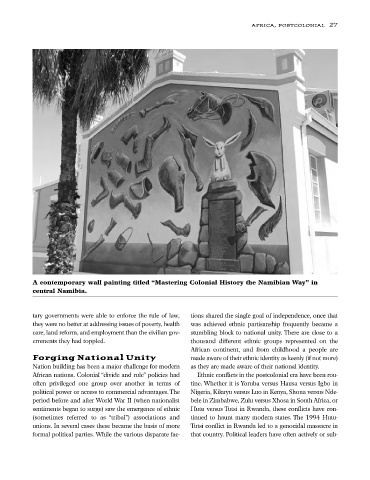
            A contemporary wall painting titled “Mastering Colonial History the Namibian Way” in
            central Namibia.


            tary governments were able to enforce the rule of law,  tions shared the single goal of independence, once that
            they were no better at addressing issues of poverty, health  was achieved ethnic partisanship frequently became a
            care, land reform, and employment than the civilian gov-  stumbling block to national unity. There are close to a
            ernments they had toppled.                          thousand different ethnic groups represented on the
                                                                African continent, and from childhood a people are
            Forging National Unity                              made aware of their ethnic identity as keenly (if not more)
            Nation building has been a major challenge for modern  as they are made aware of their national identity.
            African nations. Colonial “divide and rule” policies had  Ethnic conflicts in the postcolonial era have been rou-
            often privileged one group over another in terms of  tine. Whether it is Yoruba versus Hausa versus Igbo in
            political power or access to commercial advantages.The  Nigeria, Kikuyu versus Luo in Kenya, Shona versus Nde-
            period before and after World War II (when nationalist  bele in Zimbabwe, Zulu versus Xhosa in South Africa, or
            sentiments began to surge) saw the emergence of ethnic  Hutu versus Tutsi in Rwanda, these conflicts have con-
            (sometimes referred to as  “tribal”) associations and  tinued to haunt many modern states. The 1994 Hutu-
            unions. In several cases these became the basis of more  Tutsi conflict in Rwanda led to a genocidal massacre in
            formal political parties. While the various disparate fac-  that country. Political leaders have often actively or sub-

