


Page 137 - Berkshire Encyclopedia Of World History Vol I - Abraham to Coal
P. 137
22 berkshire encyclopedia of world history


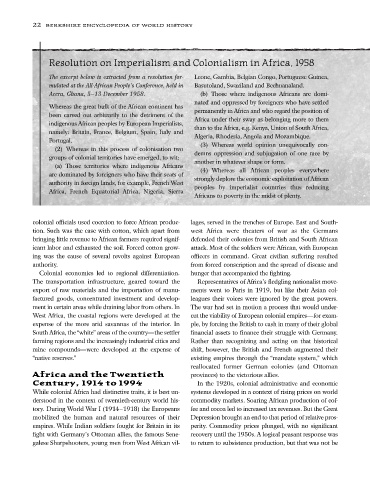
                 Resolution on Imperialism and Colonialism in Africa, 1958

                 The excerpt below is extracted from a resolution for-  Leone, Gambia, Belgian Congo, Portuguese Guinea,
                 mulated at the All-African People’s Conference, held in  Basutoland, Swaziland and Bechuanaland.
                 Accra, Ghana, 5–13 December 1958.                 (b) Those where indigenous Africans are domi-
                                                                 nated and oppressed by foreigners who have settled
                 Whereas the great bulk of the African continent has
                                                                 permanently in Africa and who regard the position of
                 been carved out arbitrarily to the detriment of the
                                                                 Africa under their sway as belonging more to them
                 indigenous African peoples by European Imperialists,
                                                                 than to the Africa, e.g. Kenya, Union of South Africa,
                 namely: Britain, France, Belgium, Spain, Italy and
                                                                 Algeria, Rhodesia, Angola and Mozambique.
                 Portugal.
                                                                   (3) Whereas world opinion unequivocally con-
                   (2) Whereas in this process of colonisation two
                                                                 demns oppression and subjugation of one race by
                 groups of colonial territories have emerged, to wit:
                                                                 another in whatever shape or form.
                   (a) Those territories where indigenous  Africans
                                                                   (4) Whereas all  African peoples everywhere
                 are dominated by foreigners who have their seats of
                                                                 strongly deplore the economic exploitation of African
                 authority in foreign lands, for example, French West
                                                                 peoples by imperialist countries thus reducing
                 Africa, French Equatorial  Africa, Nigeria, Sierra
                                                                 Africans to poverty in the midst of plenty.
            colonial officials used coercion to force African produc-  lages, served in the trenches of Europe. East and South-
            tion. Such was the case with cotton, which apart from  west  Africa were theaters of war as the Germans
            bringing little revenue to African farmers required signif-  defended their colonies from British and South African
            icant labor and exhausted the soil. Forced cotton grow-  attack. Most of the soldiers were African, with European
            ing was the cause of several revolts against European  officers in command. Great civilian suffering resulted
            authority.                                          from forced conscription and the spread of disease and
              Colonial economics led to regional differentiation.  hunger that accompanied the fighting.
            The transportation infrastructure, geared toward the  Representatives of Africa’s fledgling nationalist move-
            export of raw materials and the importation of manu-  ments went to Paris in 1919, but like their Asian col-
            factured goods, concentrated investment and develop-  leagues their voices were ignored by the great powers.
            ment in certain areas while draining labor from others. In  The war had set in motion a process that would under-
            West Africa, the coastal regions were developed at the  cut the viability of European colonial empires—for exam-
            expense of the more arid savannas of the interior. In  ple, by forcing the British to cash in many of their global
            South Africa, the “white” areas of the country—the settler  financial assets to finance their struggle with Germany.
            farming regions and the increasingly industrial cities and  Rather than recognizing and acting on that historical
            mine compounds—were developed at the expense of     shift, however, the British and French augmented their
            “native reserves.”                                  existing empires through the “mandate system,” which
                                                                reallocated former German colonies (and Ottoman
            Africa and the Twentieth                            provinces) to the victorious allies.
            Century, 1914 to 1994                                 In the 1920s, colonial administrative and economic
            While colonial Africa had distinctive traits, it is best un-  systems developed in a context of rising prices on world
            derstood in the context of twentieth-century world his-  commodity markets. Soaring African production of cof-
            tory. During World War I (1914–1918) the Europeans  fee and cocoa led to increased tax revenues. But the Great
            mobilized the human and natural resources of their  Depression brought an end to that period of relative pros-
            empires. While Indian soldiers fought for Britain in its  perity. Commodity prices plunged, with no significant
            fight with Germany’s Ottoman allies, the famous Sene-  recovery until the 1950s.A logical peasant response was
            galese Sharpshooters, young men from West African vil-  to return to subsistence production, but that was not be

