


Page 139 - Berkshire Encyclopedia Of World History Vol I - Abraham to Coal
P. 139
24 berkshire encyclopedia of world history


                                       If you are neutral in situations of injustice, you have chosen the side of the oppressor.
                                       If an elephant has its foot on the tail of a mouse and you say that you are neutral, the
                                                 mouse will not appreciate your neutrality. • Desmond Tutu (b. 1931)


            The Congo became a Cold War battlefield as independ-  communist stance of its leaders. But major uprisings
            ence led to civil war, with the United States successfully  throughout the late 1970s and 1980s, in which African
            backing an authoritarian, anticommunist dictator named  students played a major role, kept pressure on the regime.
            Mobutu Sese Seko. Portugal refused to give up its colonies  In 1994 Nelson Mandela became the first president of a
            without a fight, and its NATO-backed government fought  democratic South Africa.The colonial era in African his-
            a long war with Soviet-supported insurgents before the  tory was finally at an end.
            independence of Angola and Mozambique in 1974. Sim-
            ilarly, Marxist guerrillas fought the white settler regime in  The Legacies of Colonialism
            Rhodesia, finally securing majority rule in 1980 and  Political geography is perhaps the most obvious legacy of
            renaming their country Zimbabwe.                    colonialism. With a map created by Europeans for their
              In South  Africa, the struggle was even more pro-  own purposes, Africans have struggled to create viable
            longed. Even after the fight against German fascism had  nations within the borders bequeathed to them. The
            discredited racism as a political ideology, white South  problem of creating strong nation-states has been com-
            African voters supported the creation of an apartheid  pounded by other political legacies of colonialism. Eth-
            state after 1948. Under the leadership of Nelson Man-  nic politics is one example. As elsewhere in the world,
            dela, the  African National Congress used nonviolent  when mass politics developed in Africa there was a ten-
            civil disobedience to oppose apartheid, but the response  dency for ethnic and/or religious identifications to be
            was increased repression. In 1964, Mandela and his col-  heightened. The development of such ethnic identities
            leagues were sentenced to life in prison after they turned  was often encouraged by colonial powers as part of a
            to sabotage as a means of resistance. In a Cold War con-  divide-and-rule strategy. Since such identities rarely cor-
            text, the United States and Great Britain were reluctant  responded with national boundaries, ethnic subnation-
            to put too much pressure on the apartheid regime, given  alism became a major challenge to national cohesion in
            the significant Western investment in South Africa’s prof-  new African states.The legacy of authoritarian rule inher-
            itable mining and industrial sectors and the strongly anti-  ited from colonialism, with weak structures of civil soci-


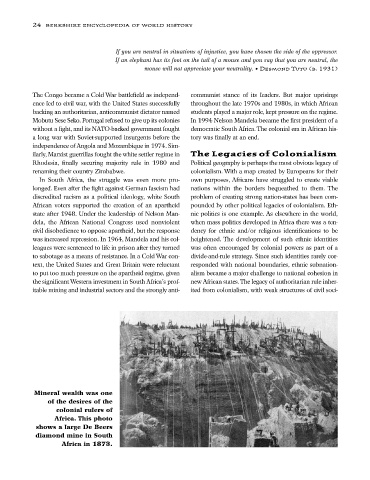
            Mineral wealth was one
                 of the desires of the
                    colonial rulers of
                   Africa. This photo
             shows a large De Beers
             diamond mine in South
                     Africa in 1873.

