


Page 135 - Berkshire Encyclopedia Of World History Vol I - Abraham to Coal
P. 135
20 berkshire encyclopedia of world history


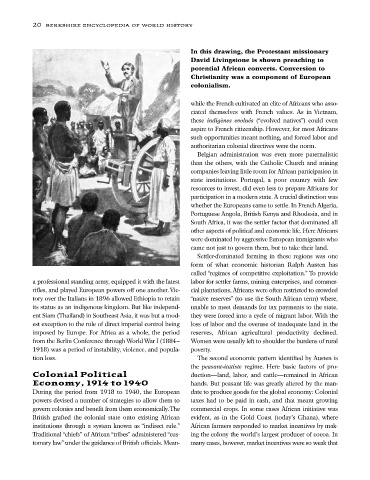
                                                                In this drawing, the Protestant missionary
                                                                David Livingstone is shown preaching to
                                                                potential African converts. Conversion to
                                                                Christianity was a component of European
                                                                colonialism.


                                                                while the French cultivated an elite of Africans who asso-
                                                                ciated themselves with French values. As in Vietnam,
                                                                these  indigènes evolués (“evolved natives”) could even
                                                                aspire to French citizenship. However, for most Africans
                                                                such opportunities meant nothing, and forced labor and
                                                                authoritarian colonial directives were the norm.
                                                                  Belgian administration was even more paternalistic
                                                                than the others, with the Catholic Church and mining
                                                                companies leaving little room for African participation in
                                                                state institutions. Portugal, a poor country with few
                                                                resources to invest, did even less to prepare Africans for
                                                                participation in a modern state.A crucial distinction was
                                                                whether the Europeans came to settle. In French Algeria,
                                                                Portuguese Angola, British Kenya and Rhodesia, and in
                                                                South Africa, it was the settler factor that dominated all
                                                                other aspects of political and economic life. Here Africans
                                                                were dominated by aggressive European immigrants who
                                                                came not just to govern them, but to take their land.
                                                                  Settler-dominated farming in these regions was one
                                                                form of what economic historian Ralph  Austen has
                                                                called “regimes of competitive exploitation.” To provide
            a professional standing army, equipped it with the latest  labor for settler farms, mining enterprises, and commer-
            rifles, and played European powers off one another.Vic-  cial plantations,Africans were often restricted to crowded
            tory over the Italians in 1896 allowed Ethiopia to retain  “native reserves” (to use the South African term) where,
            its status as an indigenous kingdom. But like independ-  unable to meet demands for tax payments to the state,
            ent Siam (Thailand) in Southeast Asia, it was but a mod-  they were forced into a cycle of migrant labor. With the
            est exception to the rule of direct imperial control being  loss of labor and the overuse of inadequate land in the
            imposed by Europe. For Africa as a whole, the period  reserves, African agricultural productivity declined.
            from the Berlin Conference through World War I (1884–  Women were usually left to shoulder the burdens of rural
            1918) was a period of instability, violence, and popula-  poverty.
            tion loss.                                            The second economic pattern identified by Austen is
                                                                the  peasant-étatiste regime. Here basic factors of pro-
            Colonial Political                                  duction—land, labor, and cattle—remained in African
            Economy, 1914 to 1940                               hands. But peasant life was greatly altered by the man-
            During the period from 1918 to 1940, the European   date to produce goods for the global economy: Colonial
            powers devised a number of strategies to allow them to  taxes had to be paid in cash, and that meant growing
            govern colonies and benefit from them economically.The  commercial crops. In some cases African initiative was
            British grafted the colonial state onto existing African  evident, as in the Gold Coast (today’s Ghana), where
            institutions through a system known as “indirect rule.”  African farmers responded to market incentives by mak-
            Traditional “chiefs” of African “tribes” administered “cus-  ing the colony the world’s largest producer of cocoa. In
            tomary law” under the guidance of British officials. Mean-  many cases, however, market incentives were so weak that

