


Page 131 - Berkshire Encyclopedia Of World History Vol I - Abraham to Coal
P. 131
16 berkshire encyclopedia of world history


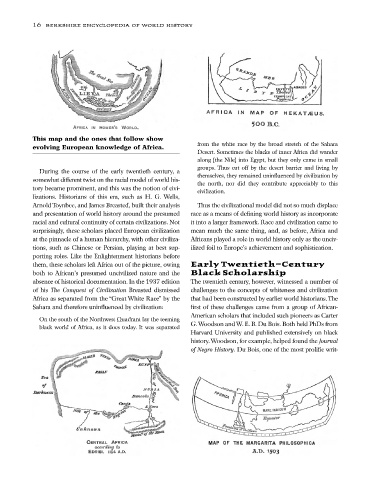
            This map and the ones that follow show
                                                                  from the white race by the broad stretch of the Sahara
            evolving European knowledge of Africa.
                                                                  Desert. Sometimes the blacks of inner Africa did wander
                                                                  along [the Nile] into Egypt, but they only came in small
                                                                  groups. Thus cut off by the desert barrier and living by
              During the course of the early twentieth century, a
                                                                  themselves, they remained uninfluenced by civilization by
            somewhat different twist on the racial model of world his-
                                                                  the north, nor did they contribute appreciably to this
            tory became prominent, and this was the notion of civi-
                                                                  civilization.
            lizations. Historians of this era, such as H. G. Wells,
            Arnold Toynbee, and James Breasted, built their analysis  Thus the civilizational model did not so much displace
            and presentation of world history around the presumed  race as a means of defining world history as incorporate
            racial and cultural continuity of certain civilizations. Not  it into a larger framework. Race and civilization came to
            surprisingly, these scholars placed European civilization  mean much the same thing, and, as before, Africa and
            at the pinnacle of a human hierarchy, with other civiliza-  Africans played a role in world history only as the unciv-
            tions, such as Chinese or Persian, playing at best sup-  ilized foil to Europe’s achievement and sophistication.
            porting roles. Like the Enlightenment historians before
            them, these scholars left Africa out of the picture, owing  Early Twentieth-Century
            both to African’s presumed uncivilized nature and the  Black Scholarship
            absence of historical documentation. In the 1937 edition  The twentieth century, however, witnessed a number of
            of his The Conquest of Civilization Breasted dismissed  challenges to the concepts of whiteness and civilization
            Africa as separated from the “Great White Race” by the  that had been constructed by earlier world historians.The
            Sahara and therefore uninfluenced by civilization:   first of these challenges came from a group of African-
                                                                American scholars that included such pioneers as Carter
              On the south of the Northwest Quadrant lay the teeming
                                                                G.Woodson and W. E. B. Du Bois. Both held PhDs from
              black world of Africa, as it does today. It was separated
                                                                Harvard University and published extensively on black
                                                                history.Woodson, for example, helped found the Journal
                                                                of Negro History. Du Bois, one of the most prolific writ-

