


Page 128 - Berkshire Encyclopedia Of World History Vol I - Abraham to Coal
P. 128
africa 13


                                                                            Advice to Persons About to Write History—
                                                                              Don’t. • Lord Acton (1834–1902)


            Schlegel, A., & Barry, H., III. (1991). Adolescence: An anthropological  centric argument that the term is actually ancient Egypt-
              inquiry. New York: Free Press.                    ian in origin, from Af-Rui-Ka, meaning “place of begin-
            Worthman, C. (1999). Evolutionary perspectives on the onset of puberty.
              In W.Trevathan, E. O. Smith, & J. McKenna (Eds.), Evolutionary med-  nings.” Whatever the origins of the term, by the fifteenth
              icine (pp. 135–164). New York: Oxford University Press.  century Africa was winning out against competing terms
                                                                such as Ethiopia and Libya to become the common iden-
                                                                tifier for the continent. If one looks at maps of Africa pro-
                                                                duced during the fifteenth through seventeenth centuries,
                                            Africa              once can see Africa increasingly come to dominate as the
                                                                name of the continent. The controversy over the land-
                frica has played a number of often contradictory  mass’s name serves as foreshadowing for the deeper
            Aroles in the writing of world history. Indeed, perhaps  conflicts over its meaning and relevance in world history.
            no single world region has played so contentious a role
            in the field. Africa has been derided by some scholars as  Early Conceptions
            irrelevant to world history. Conversely, others have  of Africa
            argued that Africa lies at the very center of human history.  The field of history as we know it today is largely a West-
            What could possibly account for such utterly incompat-  ern European creation. It should be no surprise, then,
            ible perspectives? The answer to the question is itself his-  that the earliest attempts at writing histories of the world
            torical. Over the past several hundred years, the history
            of Africa has been viewed through a variety of lenses, and
            these lenses have greatly influenced the way the history
            of Africa has been understood. Similarly, as the range of
            academic thinking has expanded and diversified in recent
            years, so have the number of lenses for understanding
            Africa. Rather than seeing the various contradictory
            notions of Africa as a failing of history, however, it might
            be more useful to look at the situation as instructive. By
            examining the great variety of ways in which Africa has
            been understood in the past few hundred years, we gain
            a remarkable insight into not only the complex part of
            the world known as Africa, but also into the growth and
            development of the field of world history itself.

            Origins of the Name Africa
            The very origin of the name Africa is contentious. The
            most common scholarly explanation is that it comes from
            the Roman Africa terra, or “land of the Afri” in reference
            to a Berber-speaking society that once lived in what is
            nowTunisia. One alternative explanation is that it comes
            from the Latin aprica (sunny) or the Phoenician term afar
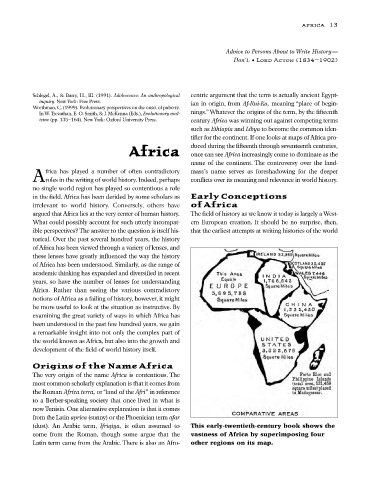
            (dust). An Arabic term, Ifriqiya, is often assumed to  This early-twentieth-century book shows the
            come from the Roman, though some argue that the     vastness of Africa by superimposing four
            Latin term came from the Arabic. There is also an Afro-  other regions on its map.

