


Page 133 - Berkshire Encyclopedia Of World History Vol I - Abraham to Coal
P. 133
18 berkshire encyclopedia of world history


            means of reconstructing the  African past. Over the
            decades since, the results of this research have established
            a rich and varied historiography. Such a body of histori-
            cal knowledge could not be ignored by world historians,
            and as a result world history texts could no longer dis-
            count Africa as being without history.
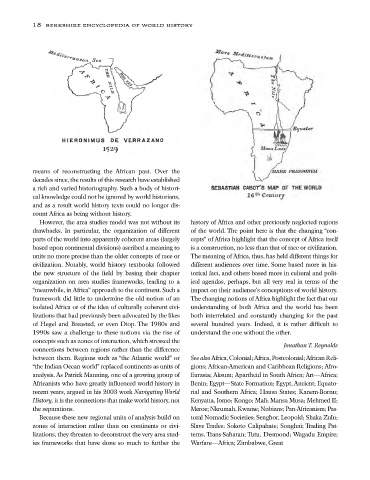
              However, the area studies model was not without its  history of Africa and other previously neglected regions
            drawbacks. In particular, the organization of different  of the world. The point here is that the changing “con-
            parts of the world into apparently coherent areas (largely  cepts” of Africa highlight that the concept of Africa itself
            based upon continental divisions) ascribed a meaning to  is a construction, no less than that of race or civilization.
            units no more precise than the older concepts of race or  The meaning of Africa, thus, has held different things for
            civilization. Notably, world history textbooks followed  different audiences over time. Some based more in his-
            the new structure of the  field by basing their chapter  torical fact, and others based more in cultural and polit-
            organization on area studies frameworks, leading to a  ical agendas, perhaps, but all very real in terms of the
            “meanwhile, in Africa” approach to the continent. Such a  impact on their audience’s conceptions of world history.
            framework did little to undermine the old notion of an  The changing notions of Africa highlight the fact that our
            isolated Africa or of the idea of culturally coherent civi-  understanding of both Africa and the world has been
            lizations that had previously been advocated by the likes  both interrelated and constantly changing for the past
            of Hegel and Breasted, or even Diop. The 1980s and  several hundred years. Indeed, it is rather difficult to
            1990s saw a challenge to these notions via the rise of  understand the one without the other.
            concepts such as zones of interaction, which stressed the
                                                                                               Jonathan T. Reynolds
            connections between regions rather than the difference
            between them. Regions such as “the Atlantic world” or  See alsoAfrica,Colonial;Africa,Postcolonial;African Reli-
            “the Indian Ocean world” replaced continents as units of  gions; African-American and Caribbean Religions; Afro-
            analysis. As Patrick Manning, one of a growing group of  Eurasia; Aksum; Apartheid in South Africa; Art—Africa;
            Africanists who have greatly influenced world history in  Benin; Egypt—State Formation; Egypt,Ancient; Equato-
            recent years, argued in his 2003 work Navigating World  rial and Southern Africa; Hausa States; Kanem-Bornu;
            History, it is the connections that make world history, not  Kenyatta, Jomo; Kongo; Mali; Mansa Musa; Mehmed II;
            the separations.                                    Meroe; Nkrumah,Kwame; Nubians; Pan-Africanism; Pas-
              Because these new regional units of analysis build on  toral Nomadic Societies; Senghor, Leopold; Shaka Zulu;
            zones of interaction rather than on continents or civi-  Slave Trades; Sokoto Calipahate; Songhai; Trading Pat-
            lizations, they threaten to deconstruct the very area stud-  terns, Trans-Saharan; Tutu, Desmond; Wagadu Empire;
            ies frameworks that have done so much to further the  Warfare—Africa; Zimbabwe, Great

