


Page 113 - Encyclopedia Of World History Vol III
P. 113
932 berkshire encyclopedia of world history


                                     Observe constantly that all things take place by change, and accustom thyself to consider
                                           that the nature of the Universe loves nothing so much as to change the things that
                                            are, and to make new things like them. • Marcus Aurelius (121–180 ce)


            evolution as the development of walking, speaking, and  nized the cooling effects of upright posture, the advan-
            the hunting-gathering adaptation remain subjects of sig-  tages of a panoramic view, especially when striding
            nificant debate.                                     through tall grass, and the convenience of carrying food,
                                                                artifacts, or children with free hands. The occasional
            Earliest Hominids                                   bipedalism that natural selection steadily reinforced as
            Despite unresolved disagreements and uncertainties, and  australopithecines adapted to their special niche set the
            evidence for the development of a discernibly upright  stage for the subsequent evolution of every other funda-
            posture in primate evolution, paleoanthropologists have  mental feature that separates us from our hominoid
            focused on bipedal locomotion, the peculiar human   cousins. It probably contributed to such physical modi-
            capacity to walk efficiently on two legs with a fully erect  fications as progressive hair loss, improved sweat glands,
            posture, as the key to understanding what separated our  and the refinement of the human hand. By indirectly
            oldest forebears from other hominoids. Indisputably,Aus-  encouraging tool use and heightened levels of social
            tralopithecines living in eastern and southern Africa had  interaction, it may even have served as a fountainhead for
            ape bodies adapted to permit upright balance and a  the development of cultural behavior.
            striding gait. Bipedalism represented a beneficial adap-  For several decades after the discovery of Australop-
            tive response to Africa’s expanding open woodlands and  ithecus afarensis in 1974, paleoanthropologists devoted
            savanna environments. Compelled to traverse the con-  considerable attention to the fossil evidence for this rel-
            siderable distances between shrinking wooded areas as  atively small, gracile species known as Australopithecus
            they foraged for sustenance or sought a refuge as night-  afarensis, which lived in East Africa between 4 and 3 mil-
            fall approached, our distant forebears must have recog-  lion years ago. Still viewed by most investigators as the
                                                                common ancestor of all subsequent hominid forms,
                                                                afarensis possessed an almost humanlike skeleton below
                                                                the neck, but a braincase only about one-third that of the
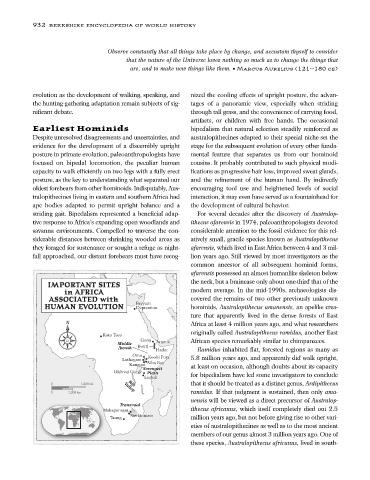
                 IMPORTANT SITES
                                                                modern average. In the mid-1990s, archaeologists dis-
                      in AFRICA
                 ASSOCIATED with                                covered the remains of two other previously unknown
                                              Fayyum
                HUMAN EVOLUTION               Depression        hominids, Australopithecus amanensis, an apelike crea-
                                                                ture that apparently lived in the dense forests of East
                       N                                        Africa at least 4 million years ago, and what researchers
                                                                originally called Australopithecus ramidus, another East
                                   Koto Toro
                                               Gona
                                        Middle       Aramis     African species remarkably similar to chimpanzees.
                                        Awash  Bouri
                                                    Hadar         Ramidus inhabited flat, forested regions as many as
                                             Omo  Koobi Fora
                                         Lothagam               5.8 million years ago, and apparently did walk upright,
                                            Kanapoi  Allia Bay
                                                Serengeti       at least on occasion, although doubts about its capacity
                                       Olduvai Gorge  Plain
                                                 Laetoli        for bipedialism have led some investigators to conclude
                  0         1,200 mi      Valley                that it should be treated as a distinct genus, Ardipithecus
                                           Rift
                  0     1,200 km                                ramidus. If that judgment is sustained, then only ama-
                                                                nensis will be viewed as a direct precursor of Australop-
                                         Transvaal
                                   Makapansgat                  ithecus africanus, which itself completely died out 2.5
                                            Sterkfontein
                                     Taung                      million years ago, but not before giving rise to other vari-
                                                                eties of australopithecines as well as to the most ancient
                                                                members of our genus almost 3 million years ago. One of
                                                                these species, Australopithecus africanus, lived in south-

