


Page 112 - Encyclopedia Of World History Vol III
P. 112
human evolution—overview 931


             token for each white fox. Suppose that that year the
             price of fox was twenty dollars each; we would take
             up one square token and replace it with twenty round  lution also rested on long-standing trends in primate
             one-dollar tokens. Whenever an Eskimo bought       behavior, including social learning and cooperation,
             something, the tokens representing the value of his  toolmaking, and group organization.
             purchase were removed and the change was made in     Before discussing human evolution in more detail,
             smaller tokens. The biggest trouble with these thin  however, a word about the evidence used in paleoan-
             aluminum tokens was that all our trading was done  thropology and the types of disputes that tend to arise is
             in an unheated store, and the tokens were too thin to  in order. Given the paucity of evidence available to pale-
             pick up without the trader taking off his mitts.When  oanthropologists, the immense gaps in existing knowl-
             fingers were bared, the tokens froze nicely to the skin.  edge, and the number of recent archeological finds that
             Source: Pryde, D. (1972). Nunaga: my land, my country. Edmonton, Canada: M.G. Hur-  call into question prevailing views, world historians
             tig Ltd.
                                                                should not be surprised to find the experts constantly
                                                                disagreeing among themselves about the variables of
                                                                hominid evolution. They utilize detailed site surveys,
                                                                stratigraphic observations, chronometric methods of dat-
                                                                ing, and precise forms of climatological, biomolecular,
            struct the patterns of prehistory that stretch back 5 to 7  and comparative anatomical analysis to begin to inter-
            million years, when our earliest direct ancestors in the  pret what they have found. They have increasingly
            family of hominids, an amazing variety of distinct  emphasized the diversity rather than the uniformity of
            species, notably the australopithecines, or southern apes,  early hominids and the possibility that early hominids
            diverged onto their own evolutionary line. Seventy mil-  lived widely throughout sub-Saharan Africa, but have
            lion years of primate evolution set the parameters and  remained divided over how to distinguish one species or
            determined the possibilities for the origins and develop-  genus from another, and hence over the use of proper
            ment of hominids. From their primate heritage, human  nomenclature. Such fundamentals aspects of human
            beings have derived a unique
            combination of physical attrib-
            utes, including large brains rel-
            ative to body size, eyes capable
            of binocular vision, nimble
            hands, smaller canine teeth,
            and a skeleton designed for
            upright walking. Human evo-


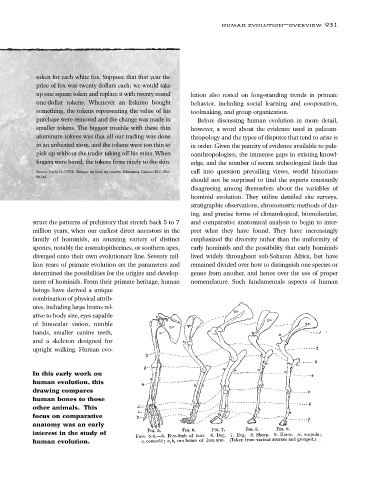
            In this early work on
            human evolution, this
            drawing compares
            human bones to those
            other animals. This
            focus on comparative
            anatomy was an early
            interest in the study of
            human evolution.

