


Page 109 - Encyclopedia Of World History Vol III
P. 109
928 berkshire encyclopedia of world history


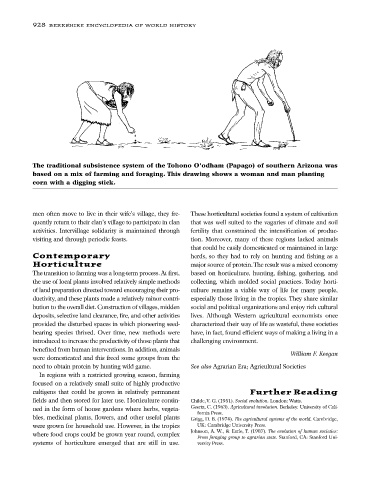
            The traditional subsistence system of the Tohono O'odham (Papago) of southern Arizona was
            based on a mix of farming and foraging. This drawing shows a woman and man planting
            corn with a digging stick.


            men often move to live in their wife’s village, they fre-  These horticultural societies found a system of cultivation
            quently return to their clan’s village to participate in clan  that was well suited to the vagaries of climate and soil
            activities. Intervillage solidarity is maintained through  fertility that constrained the intensification of produc-
            visiting and through periodic feasts.               tion. Moreover, many of these regions lacked animals
                                                                that could be easily domesticated or maintained in large
            Contemporary                                        herds, so they had to rely on hunting and fishing as a
            Horticulture                                        major source of protein.The result was a mixed economy
            The transition to farming was a long-term process.At first,  based on horticulture, hunting, fishing, gathering, and
            the use of local plants involved relatively simple methods  collecting, which molded social practices. Today horti-
            of land preparation directed toward encouraging their pro-  culture remains a viable way of life for many people,
            ductivity, and these plants made a relatively minor contri-  especially those living in the tropics. They share similar
            bution to the overall diet. Construction of villages, midden  social and political organizations and enjoy rich cultural
            deposits, selective land clearance, fire, and other activities  lives. Although Western agricultural economists once
            provided the disturbed spaces in which pioneering seed-  characterized their way of life as wasteful, these societies
            bearing species thrived. Over time, new methods were  have, in fact, found efficient ways of making a living in a
            introduced to increase the productivity of those plants that  challenging environment.
            benefited from human interventions. In addition, animals
                                                                                                 William F. Keegan
            were domesticated and this freed some groups from the
            need to obtain protein by hunting wild game.        See also Agrarian Era; Agricultural Societies
              In regions with a restricted growing season, farming
            focused on a relatively small suite of highly productive
            cultigens that could be grown in relatively permanent                   Further Reading
            fields and then stored for later use. Horticulture contin-  Childe,V. G. (1951). Social evolution. London: Watts.
            ued in the form of house gardens where herbs, vegeta-  Geertz, C. (1963). Agricultural involution. Berkeley: University of Cali-
                                                                  fornia Press.
            bles, medicinal plants, flowers, and other useful plants  Grigg, D. B. (1974). The agricultural systems of the world. Cambridge,
            were grown for household use. However, in the tropics  UK: Cambridge University Press.
                                                                Johnson, A. W., & Earle, T. (1987). The evolution of human societies:
            where food crops could be grown year round, complex
                                                                  From foraging group to agrarian state. Stanford, CA: Stanford Uni-
            systems of horticulture emerged that are still in use.  versity Press.

