


Page 107 - Encyclopedia Of World History Vol III
P. 107
926 berkshire encyclopedia of world history


            weeding, fertilizing, and pest control. The use of such  plants in a single garden because these plants mature at
            techniques increased over the years in a process that  different rates. Thus, a single garden can contain root
            anthropologist Clifford Geertz called “agricultural invo-  crops, maize, legumes, fruit trees, and other food plants.
            lution.” Greater outputs of plant foods were obtained by  Third, because most of the nutrients in the tropics are
            applying more labor to gardening processes.         bound up in the vegetation itself, nutrients can be
              Horticulture is still practiced today in most societies.  released by simply burning the vegetation before plant-
            In some societies it is a way of life, although it is typically  ing. However, the nutrients released by burning provide
            a supplement to more intensive forms of agriculture. Peo-  only a few years of soil fertility, which means that a gar-
            ple cultivate small gardens close to their homes in which  den must be abandoned before it can be planted again.
            a variety of vegetables, fruits, herbs, medicinal plants,  Finally, tropical soils tend to be extremely fragile.When
            and flowers are grown for household use.             Western agricultural economists first started to study
                                                                tropical gardens they concluded that this type of farming
            Contemporary Societies                              was inefficient. However, when they introduced large,
            Today most horticultural societies live in the tropics.  open fields with a single cultigen there was a high rate of
            There are several reasons for this. First, the climate allows  soil erosion during the rainy season and the soils were
            for the cultivation of food crops year round, unlike tem-  baked by the sun into unproductive hardpans within a
            perate regions in which farming is limited to particular  few years. It turned out that horticulture was well suited
            seasons. Second, it is possible to grow a wide variety of  to the climate and soil characteristics of the tropics.
                                                                Small fields covered with plants protect the soil from
                                                                heavy rains and insolation and provide a continuous sup-
                                                                ply of food throughout the year.
                                                                  Farming is only one part of horticultural economies.
                                                                Tropical cultigens tend to be rich in starch but lacking in
                                                                protein so meat or fish must also be obtained to provide
                                                                an adequate diet. Some horticulturalists keep domesti-
                                                                cated animals as a source of protein (for example, pigs,
                                                                goats, sheep, chickens, or guinea pigs), but they tend to
                                                                rely more heavily on hunting or fishing as the main
                                                                source.They also collect a variety of wild foods from the
                                                                forest—for instance, fruits, nuts, honey, and grubs. In
                                                                sum, this is a truly mixed economy that combines farm-
                                                                ing, hunting, fishing, gathering, and collecting.
                                                                  The requirements of these different strategies place
                                                                certain constraints on the organization of horticultural
                                                                societies. Although they vary according to the particu-
                                                                lars of their area, they share certain cultural practices.


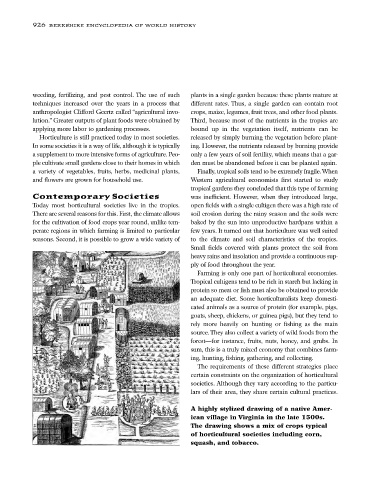
                                                                A highly stylized drawing of a native Amer-
                                                                ican village in Virginia in the late 1500s.
                                                                The drawing shows a mix of crops typical
                                                                of horticultural societies including corn,
                                                                squash, and tobacco.

