


Page 148 - Encyclopedia Of World History Vol III
P. 148
indigenous peoples 967


            when they did so, they were summarily executed in 1929.
            Stalin’s actions halved the Buryat population.The Tuva also
            resisted collectivization in the 1930s, but the Terror of
            1937 led to the murder of the nationalists.The declaration
            of the Tuva region as an autonomous province in 1944 did
            not help. The Tuva were put into boarding schools and
            “Russianized,” while Stalin encouraged Russian colonists
            to diminish the population of indigenous peoples.
              Only the fall of the Soviet Union in 1989 has im-
            proved the political situation of some of the indigenous
            peoples of Siberia and Central Asia. In Central Asia, some
            of the previously indigenous people saw themselves trans-
            formed almost overnight into national groups, such as in
            Kazakhstan, Kyrgyzstan, Tajikistan, and Uzbekistan.
            Unfortunately, many of these new nations are still ruled
            by autocrats, often old Communist apparatchiks from the
            pre-independence era.
              The Chinese Communist state instituted similar poli-
            cies to the Soviet Union in Xianjiang after 1949 and Tibet
            after the 1950 invasion. The process of “Sinification” of
            the western borders of China appears to have accelerated
            in the last few decades of the twentieth century as increas-
            ing prosperity and overpopulation in the eastern sections
            brings more Han Chinese westward. The Chinese state
            has defined any resistance by ethnic minorities especially
            in the West as “terrorism,” thus providing for a police or
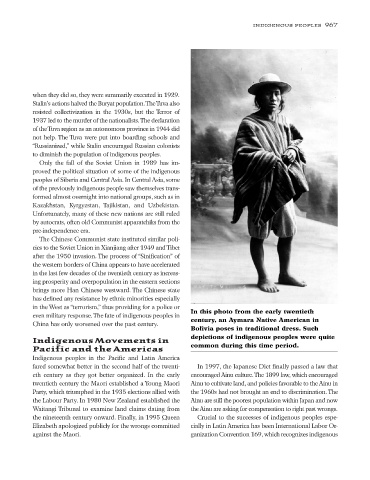
                                                                In this photo from the early twentieth
            even military response.The fate of indigenous peoples in
                                                                century, an Aymara Native American in
            China has only worsened over the past century.
                                                                Bolivia poses in traditional dress. Such
                                                                depictions of indigenous peoples were quite
            Indigenous Movements in
                                                                common during this time period.
            Pacific and the Americas
            Indigenous peoples in the Pacific and Latin  America
            fared somewhat better in the second half of the twenti-  In 1997, the Japanese Diet finally passed a law that
            eth century as they got better organized. In the early  encouraged Ainu culture.The 1899 law, which encouraged
            twentieth century the Maori established a Young Maori  Ainu to cultivate land, and policies favorable to the Ainu in
            Party, which triumphed in the 1935 elections allied with  the 1960s had not brought an end to discrimination.The
            the Labour Party. In 1980 New Zealand established the  Ainu are still the poorest population within Japan and now
            Waitangi Tribunal to examine land claims dating from  the Ainu are asking for compensation to right past wrongs.
            the nineteenth century onward. Finally, in 1995 Queen  Crucial to the successes of indigenous peoples espe-
            Elizabeth apologized publicly for the wrongs committed  cially in Latin America has been International Labor Or-
            against the Maori.                                  ganization Convention 169,which recognizes indigenous

