


Page 153 - Encyclopedia Of World History Vol III
P. 153
972 berkshire encyclopedia of world history


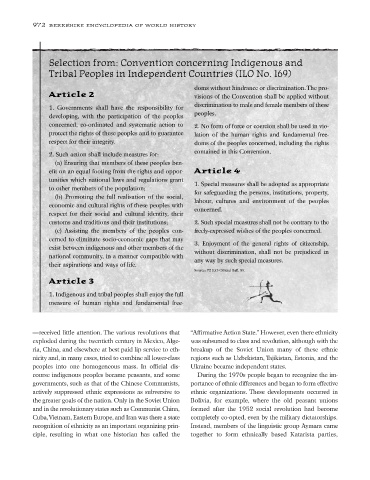
                 Selection from: Convention concerning Indigenous and
                 Tribal Peoples in Independent Countries (ILO No. 169)


                                                                 doms without hindrance or discrimination.The pro-
                 Article 2                                       visions of the Convention shall be applied without
                                                                 discrimination to male and female members of these
                 1. Governments shall have the responsibility for
                                                                 peoples.
                 developing, with the participation of the peoples
                 concerned, co-ordinated and systematic action to  2. No form of force or coercion shall be used in vio-
                 protect the rights of these peoples and to guarantee  lation of the human rights and fundamental free-
                 respect for their integrity.                    doms of the peoples concerned, including the rights
                                                                 contained in this Convention.
                 2. Such action shall include measures for:
                   (a) Ensuring that members of these peoples ben-
                 efit on an equal footing from the rights and oppor-  Article 4
                 tunities which national laws and regulations grant
                                                                 1. Special measures shall be adopted as appropriate
                 to other members of the population;
                                                                 for safeguarding the persons, institutions, property,
                   (b) Promoting the full realisation of the social,
                                                                 labour, cultures and environment of the peoples
                 economic and cultural rights of these peoples with
                                                                 concerned.
                 respect for their social and cultural identity, their
                 customs and traditions and their institutions;  2. Such special measures shall not be contrary to the
                   (c)  Assisting the members of the peoples con-  freely-expressed wishes of the peoples concerned.
                 cerned to eliminate socio-economic gaps that may
                                                                 3. Enjoyment of the general rights of citizenship,
                 exist between indigenous and other members of the
                                                                 without discrimination, shall not be prejudiced in
                 national community, in a manner compatible with
                                                                 any way by such special measures.
                 their aspirations and ways of life.
                                                                 Source: 72 ILO Official Bull. 59.
                 Article 3
                 1. Indigenous and tribal peoples shall enjoy the full
                 measure of human rights and fundamental free-


            —received little attention. The various revolutions that  “Affirmative Action State.” However, even there ethnicity
            exploded during the twentieth century in Mexico, Alge-  was subsumed to class and revolution, although with the
            ria, China, and elsewhere at best paid lip service to eth-  breakup of the Soviet Union many of these ethnic
            nicity and, in many cases, tried to combine all lower-class  regions such as Uzbekistan, Tajikistan, Estonia, and the
            peoples into one homogeneous mass. In official dis-  Ukraine became independent states.
            course indigenous peoples became peasants, and some   During the 1970s people began to recognize the im-
            governments, such as that of the Chinese Communists,  portance of ethnic differences and began to form effective
            actively suppressed ethnic expressions as subversive to  ethnic organizations. These developments occurred in
            the greater goals of the nation. Only in the Soviet Union  Bolivia, for example, where the old peasant unions
            and in the revolutionary states such as Communist China,  formed after the 1952 social revolution had become
            Cuba,Vietnam, Eastern Europe, and Iran was there a state  completely co-opted, even by the military dictatorships.
            recognition of ethnicity as an important organizing prin-  Instead, members of the linguistic group Aymara came
            ciple, resulting in what one historian has called the  together to form ethnically based Katarista parties,

