


Page 149 - Encyclopedia Of World History Vol III
P. 149
968 berkshire encyclopedia of world history


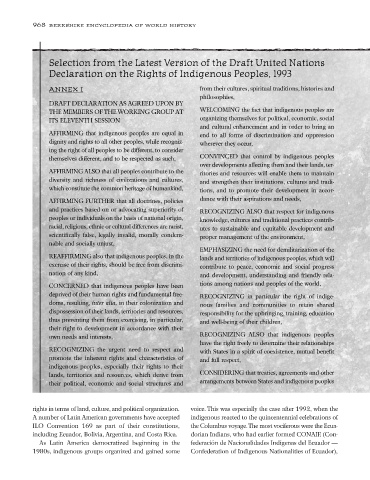
                 Selection from the Latest Version of the Draft United Nations
                 Declaration on the Rights of Indigenous Peoples, 1993


                 ANNEX I                                           from their cultures, spiritual traditions, histories and
                                                                   philosophies,
                 DRAFT DECLARATION AS AGREED UPON BY
                                                                   WELCOMING the fact that indigenous peoples are
                 THE MEMBERS OF THE WORKING GROUP AT
                                                                   organizing themselves for political, economic, social
                 ITS ELEVENTH SESSION
                                                                   and cultural enhancement and in order to bring an
                 AFFIRMING that indigenous peoples are equal in    end to all forms of discrimination and oppression
                 dignity and rights to all other peoples, while recogniz-  wherever they occur,
                 ing the right of all peoples to be different, to consider
                                                                   CONVINCED that control by indigenous peoples
                 themselves different, and to be respected as such,
                                                                   over developments affecting them and their lands, ter-
                 AFFIRMING ALSO that all peoples contribute to the  ritories and resources will enable them to maintain
                 diversity and richness of civilizations and cultures,  and strengthen their institutions, cultures and tradi-
                 which constitute the common heritage of humankind,  tions, and to promote their development in accor-
                                                                   dance with their aspirations and needs,
                 AFFIRMING FURTHER that all doctrines, policies
                 and practices based on or advocating superiority of  RECOGNIZING ALSO that respect for indigenous
                 peoples or individuals on the basis of national origin,  knowledge, cultures and traditional practices contrib-
                 racial, religious, ethnic or cultural differences are racist,  utes to sustainable and equitable development and
                 scientifically false, legally invalid, morally condem-  proper management of the environment,
                 nable and socially unjust,
                                                                   EMPHASIZING the need for demilitarization of the
                 REAFFIRMING also that indigenous peoples, in the  lands and territories of indigenous peoples, which will
                 exercise of their rights, should be free from discrimi-  contribute to peace, economic and social progress
                 nation of any kind,                               and development, understanding and friendly rela-
                                                                   tions among nations and peoples of the world,
                 CONCERNED that indigenous peoples have been
                 deprived of their human rights and fundamental free-  RECOGNIZING in particular the right of indige-
                 doms, resulting, inter alia, in their colonization and  nous families and communities to retain shared
                 dispossession of their lands, territories and resources,  responsibility for the upbringing, training, education
                 thus preventing them from exercising, in particular,  and well-being of their children,
                 their right to development in accordance with their
                                                                   RECOGNIZING  ALSO that indigenous peoples
                 own needs and interests,
                                                                   have the right freely to determine their relationships
                 RECOGNIZING the urgent need to respect and        with States in a spirit of coexistence, mutual benefit
                 promote the inherent rights and characteristics of  and full respect,
                 indigenous peoples, especially their rights to their
                                                                   CONSIDERING that treaties, agreements and other
                 lands, territories and resources, which derive from
                                                                   arrangements between States and indigenous peoples
                 their political, economic and social structures and


            rights in terms of land, culture, and political organization.  voice.This was especially the case after 1992, when the
            A number of Latin American governments have accepted  indigenous reacted to the quincentennial celebrations of
            ILO Convention 169 as part of their constitutions,  the Columbus voyage.The most vociferous were the Ecua-
            including Ecuador, Bolivia, Argentina, and Costa Rica.  dorian Indians, who had earlier formed CONAIE (Con-
              As Latin  America democratized beginning in the   federación de Nacionalidades Indígenas del Ecuador —
            1980s, indigenous groups organized and gained some  Confederation of Indigenous Nationalities of Ecuador),

