


Page 169 - Encyclopedia Of World History Vol III
P. 169
988 berkshire encyclopedia of world history


            processing allocative information, with prices of both
            locally and internationally traded goods increasingly
            effective in indicating both information about the scarcity
            (supply) and desirability (demand) of commodities.
            Moreover, the same kind of decentralized market
            processes began to control the allocation of labor and
            land, extending the coordinating role of markets to the
            factors of production.
              In the nineteenth century, even capital markets became
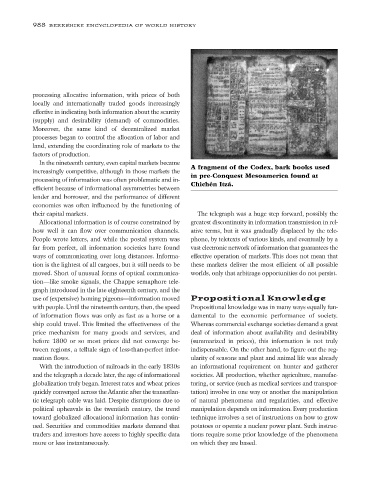
                                                                A fragment of the Codex, bark books used
            increasingly competitive, although in those markets the
                                                                in pre-Conquest Mesoamerica found at
            processing of information was often problematic and in-
                                                                Chichén Itzá.
            efficient because of informational asymmetries between
            lender and borrower, and the performance of different
            economies was often influenced by the functioning of
            their capital markets.                                The telegraph was a huge step forward, possibly the
              Allocational information is of course constrained by  greatest discontinuity in information transmission in rel-
            how well it can flow over communication channels.    ative terms, but it was gradually displaced by the tele-
            People wrote letters, and while the postal system was  phone, by teletexts of various kinds, and eventually by a
            far from perfect, all information societies have found  vast electronic network of information that guarantees the
            ways of communicating over long distances. Informa-  effective operation of markets. This does not mean that
            tion is the lightest of all cargoes, but it still needs to be  these markets deliver the most efficient of all possible
            moved. Short of unusual forms of optical communica-  worlds, only that arbitrage opportunities do not persist.
            tion—like smoke signals, the Chappe semaphore tele-
            graph introduced in the late eighteenth century, and the
            use of (expensive) homing pigeons—information moved  Propositional Knowledge
            with people. Until the nineteenth century, then, the speed  Propositional knowledge was in many ways equally fun-
            of information flows was only as fast as a horse or a  damental to the economic performance of society.
            ship could travel. This limited the effectiveness of the  Whereas commercial exchange societies demand a great
            price mechanism for many goods and services, and    deal of information about availability and desirability
            before 1800 or so most prices did not converge be-  (summarized in prices), this information is not truly
            tween regions, a telltale sign of less-than-perfect infor-  indispensable. On the other hand, to figure out the reg-
            mation flows.                                        ularity of seasons and plant and animal life was already
              With the introduction of railroads in the early 1830s  an informational requirement on hunter and gatherer
            and the telegraph a decade later, the age of informational  societies. All production, whether agriculture, manufac-
            globalization truly began. Interest rates and wheat prices  turing, or service (such as medical services and transpor-
            quickly converged across the Atlantic after the transatlan-  tation) involve in one way or another the manipulation
            tic telegraph cable was laid. Despite disruptions due to  of natural phenomena and regularities, and effective
            political upheavals in the twentieth century, the trend  manipulation depends on information. Every production
            toward globalized allocational information has contin-  technique involves a set of instructions on how to grow
            ued. Securities and commodities markets demand that  potatoes or operate a nuclear power plant. Such instruc-
            traders and investors have access to highly specific data  tions require some prior knowledge of the phenomena
            more or less instantaneously.                       on which they are based.

