


Page 164 - Encyclopedia Of World History Vol III
P. 164
industrial technologies 983


                                      God forbid that India should ever take to industrialism after the manner of the west...
                                          keeping the world in chains. If [our nation] took to similar economic exploitation,
                                         it would strip the world bare like locusts. • Mohandas Gandhi (1869–1948)


            improved techniques were tried and found to be feasible,  water power without hydraulics, dye making without
            they often disappeared because their owners kept them  organic chemistry, and medical practice without micro-
            secret or the new technique simply was too localized and  biology and immunology. Not enough was known to
            disappeared when its inventors died, before it could  generate sustained economic growth based on techno-
            become widespread. The modern age, with its competi-  logical change.
            tive globalized economy, has a number of mechanisms   In view of all this, it is amazing how much techno-
            available through which new techniques can spread rap-  logical change actually did occur in the world before
            idly (even if their use is limited in the short term by  1750. In different periods, the Chinese and the Euro-
            patent protection), but none of these existed, for exam-  peans took turns producing innovations in agriculture,
            ple, in classical antiquity. Secondly, most societies of the  textile manufacturing, shipbuilding, iron making, and the
            past were far more conservative and tradition-bound  harnessing of energy sources. Wind and water power
            than those of today. Respect for the knowledge of past  grew in importance, machines and instruments of vari-
            generations permeated most societies, and an act of  ous kinds were devised, animals were bred better and
            invention was always and everywhere an act of rebellion,  used more effectively, and new products such as paper,
            displaying disrespect for one’s ancestors and elders.This  eyeglasses, and eventually printing made the diffusion
            technological conservatism, however rational it may have  and retention of useful knowledge itself easier and
            seemed at the time, ensured that many new ideas were  cheaper.All these advances took centuries to accomplish,
            nipped in the bud. By specifying production processes in  but it cannot be doubted that in 1750 industrial tech-
            meticulous detail and being intolerant of any deviation,  nology was far more sophisticated than it had been in
            guilds and similar organizations became an instrument  the time of the Roman emperor Constantine the Great.
            of the technological status quo.
              It is also indisputable that the vast bulk of industrial  The Industrial Revolution
            technology before 1750 lacked almost entirely an under-  and the Modern World
            standing of the physical and chemical processes involved  The industrial revolution was driven by an acceleration
            in manufacturing.The “epistemic base” of the techniques  of the process of innovation.While technological change
            was exceedingly narrow. It was a world of engineering  did take place in the premodern age, it was both slow
            without mechanics, iron making without metallurgy,  and exceptional. None of this is true for our modern age:
            farming without soil science, mining without geology,  we basically  expect continuous improvement in every
                                                                area of our material existence. Many reasons have been
                                                                put forward to explain this technological takeoff. Some
                                                                have focused on the improved institutional environment
                                                                in which industrial technology operates: New techniques
                                                                are often protected by patents, and the capital goods in
                                                                which they are used are reasonably safe from predators
                                                                and tax collectors.While resistance to new technology is
                                                                still rampant in some areas such as genetic engineering
                                                                and nuclear power and a few special-interest organiza-
                                                                tions such as labor unions have exerted a braking influ-
                                                                ence on continuous progress, by and large technological
                                                                conservatism has been pushed into a corner. Modern
                                                                society has discovered the idea of industrial R&D, in
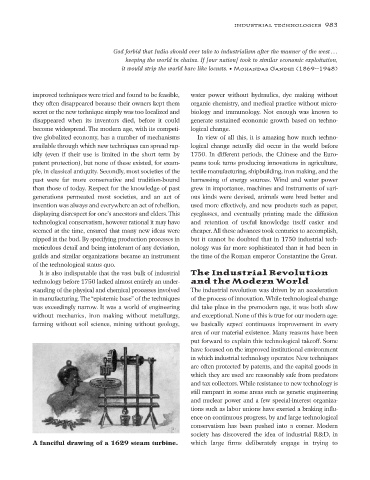
            A fanciful drawing of a 1629 steam turbine.         which large firms deliberately engage in trying to

