


Page 165 - Encyclopedia Of World History Vol III
P. 165
984 berkshire encyclopedia of world history


            improve what they do, rather than experience techno-  nology are a better understanding of energy through the
            logical progress as a more or less incidental byproduct of  laws of thermodynamics (discovered in the middle of the
            normal activity. Governments and other public agencies  nineteenth century), the understanding and control of
            have increasingly realized that human capital formation  electricity, and the discovery of the electron and the uti-
            and innovation deserve and need public support. A lit-  lization of electronics. The germ theory of disease revo-
            erate and numerate population has both higher levels of  lutionized medicine (and food processing). Routinization
            competence and the intellectual ability to unlearn known  led to mechanization, and mechanization to automation.
            techniques and relearn new ones as the technology   Some changes in industrial technology, however, relied
            around them changes.                                more on better organization and coordination than on
              But above all, modern economies are more innovative  revolutionary insights from physics: Mass production,
            because society as a whole controls more knowledge. It  interchangeable parts, continuous flow processes, and
            is doubtful that as individuals people today are much  the rise of the modern factory are all part and parcel of
            more intelligent than in the time of St. Augustine, but it  the deep changes in mankind’s use of technology.
            can hardly be disputed that collectively we know more.  The culture and technology of information storage
            Our understanding of the physical processes that under-  and transmission and the rise of competitive markets and
            lie every industrial technique has increased at an accel-  global networks of information have ensured that the peo-
            erating rate since Antoine Lavoisier published his Traité  ple who need to access pools of information and data
            Elementaire de Chimie on the eve of the French Revolu-  banks can do so at low cost. The creation of new tech-
            tion. Some of the best examples of major knowledge  nology and the growth of the underlying scientific knowl-
            breakthroughs that have revolutionized industrial tech-  edge that constitutes its epistemic base have mutually


                                                                                                    Center of
                                                                                                    industrial
                                                                                                    development
                                                                  Baltic Sea       Moscow          0  300 km
                                                                                                   0
                                                                                                         300 mi
                                               North
                                                Sea

                                        London     Amsterdam  Berlin   Warsaw
                                                   Antwerp
                                              Cologne         Dresden
                                                      Frankfurt
                   Atlantic                                    Prague
                                              Paris
                    Ocean                                        Vienna
                                  Nantes                   Munich
                                                Lyons
                                                       Milan
                                                 Genoa
                                                                                      Black Sea
                                                           Rome
                                   Madrid
                   N                                          Naples

                                     Mediterranean Sea
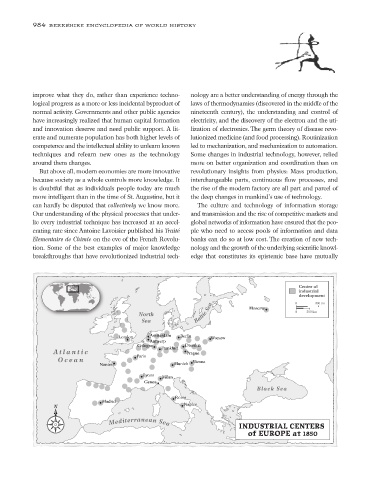
                                                                                INDUSTRIAL CENTERS
                                                                                   of EUROPE at 1850

