


Page 163 - Encyclopedia Of World History Vol III
P. 163
982 berkshire encyclopedia of world history


                                                                generation, as well as horizontally among individuals
                                                                through instruction and imitation. Needless to say, in most
                                                                past societies they were rarely written down: farmers and
                                                                artisans were rarely literate and did not really have to be
                                                                to exercise their crafts.Yet the mechanisms that passed on
                                                                industrial technologies from generation to generation
                                                                were closely linked to how the economies of these soci-
                                                                eties operated. In a primitive society of farmers and crude
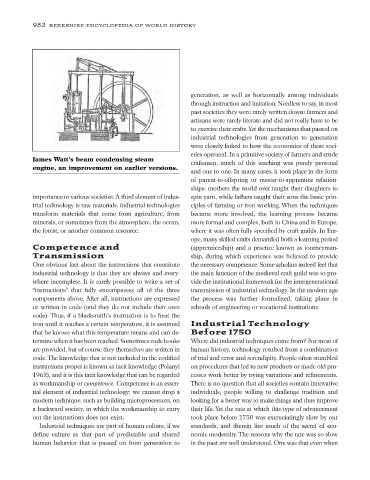
            James Watt's beam condensing steam
                                                                craftsmen, much of this teaching was purely personal
            engine, an improvement on earlier versions.
                                                                and one to one. In many cases, it took place in the form
                                                                of parent-to-offspring or master-to-apprentice relation-
                                                                ships: mothers the world over taught their daughters to
            importance in various societies.A third element of indus-  spin yarn, while fathers taught their sons the basic prin-
            trial technology is raw materials: industrial technologies  ciples of farming or iron working. When the techniques
            transform materials that come from agriculture, from  became more involved, the learning process became
            minerals, or sometimes from the atmosphere, the ocean,  more formal and complex, both in China and in Europe,
            the forest, or another common resource.             where it was often fully specified by craft guilds. In Eur-
                                                                ope, many skilled crafts demanded both a learning period
            Competence and                                      (apprenticeship) and a practice known as journeyman-
            Transmission                                        ship, during which experience was believed to provide
            One obvious fact about the instructions that constitute  the necessary competence. Some scholars indeed feel that
            industrial technology is that they are always and every-  the main function of the medieval craft guild was to pro-
            where incomplete. It is rarely possible to write a set of  vide the institutional framework for the intergenerational
            “instructions” that fully encompasses all of the three  transmission of industrial technology. In the modern age
            components above. After all, instructions are expressed  the process was further formalized, taking place in
            or written in code (and they do not include their own  schools of engineering or vocational institutions.
            code). Thus, if a blacksmith’s instruction is to heat the
            iron until it reaches a certain temperature, it is assumed  Industrial Technology
            that he knows what this temperature means and can de-  Before 1750
            termine when it has been reached.Sometimes code books  Where did industrial techniques come from? For most of
            are provided, but of course they themselves are written in  human history, technology resulted from a combination
            code.The knowledge that is not included in the codified  of trial and error and serendipity. People often stumbled
            instructions proper is known as tacit knowledge (Polanyi  on procedures that led to new products or made old pro-
            1962), and it is this tacit knowledge that can be regarded  cesses work better by trying variations and refinements.
            as workmanship or competence. Competence is an essen-  There is no question that all societies contain innovative
            tial element of industrial technology: we cannot drop a  individuals, people willing to challenge tradition and
            modern technique, such as building microprocessors, on  looking for a better way to make things and thus improve
            a backward society, in which the workmanship to carry  their life.Yet the rate at which this type of advancement
            out the instructions does not exist.                took place before 1750 was excruciatingly slow by our
              Industrial techniques are part of human culture, if we  standards, and therein lies much of the secret of eco-
            define culture as that part of predictable and shared  nomic modernity.The reasons why the rate was so slow
            human behavior that is passed on from generation to  in the past are well understood. One was that even when

