


Page 168 - Encyclopedia Of World History Vol III
P. 168
information societies 987


                                                                processed and shipped to Illinois,and how it was cooked:
                                                                By paying the price of a meal, all this information is sum-
                                                                marized and processed by people the consumer does not
                                                                know and does not have to know. On the other hand, the
                                                                Japanese wholesalers processing the tuna do not have to
                                                                know or care who precisely wants to eat what.
                                                                  Free decentralized markets are neither tools of exploi-
                                                                tation nor miracle cures for all of society’s ills; they are
                                                                above all information-cost-saving devices. Once markets
                                                                are disrupted or abolished, as happened in Marxist com-
                                                                mand economies, this information has to be processed
                                                                consciously by officials, who set prices by decree rather
                                                                than through competitive processes. The results have
                                                                been devastating.
                                                                  Money played a unique role in increasing the infor-
                                                                mational efficiency of societies, since money served as a
                                                                unique unit of account and thus made exchange easier.
                                                                Without a means of exchange, exchange would require
                                                                a double coincidence of wants, which is informationally
                                                                more cumbersome. Money also provides a measure of
                                                                value, thus providing different goods with a common
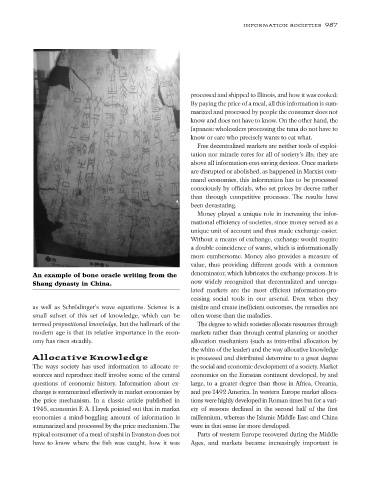
            An example of bone oracle writing from the          denominator, which lubricates the exchange process. It is
            Shang dynasty in China.                             now widely recognized that decentralized and unregu-
                                                                lated markets are the most efficient information-pro-
                                                                cessing social tools in our arsenal. Even when they
            as well as Schrödinger’s wave equations. Science is a  misfire and create inefficient outcomes, the remedies are
            small subset of this set of knowledge, which can be  often worse than the maladies.
            termed propositional knowledge, but the hallmark of the  The degree to which societies allocate resources through
            modern age is that its relative importance in the econ-  markets rather than through central planning or another
            omy has risen steadily.                             allocation mechanism (such as intra-tribal allocation by
                                                                the whim of the leader) and the way allocative knowledge
            Allocative Knowledge                                is processed and distributed determine to a great degree
            The ways society has used information to allocate re-  the social and economic development of a society. Market
            sources and reproduce itself involve some of the central  economies on the Eurasian continent developed, by and
            questions of economic history. Information about ex-  large, to a greater degree than those in Africa, Oceania,
            change is summarized effectively in market economies by  and pre-1492 America. In western Europe market alloca-
            the price mechanism. In a classic article published in  tions were highly developed in Roman times but for a vari-
            1945, economist F. A. Hayek pointed out that in market  ety of reasons declined in the second half of the first
            economies a mind-boggling amount of information is  millennium, whereas the Islamic Middle East and China
            summarized and processed by the price mechanism.The  were in that sense far more developed.
            typical consumer of a meal of sushi in Evanston does not  Parts of western Europe recovered during the Middle
            have to know where the fish was caught, how it was   Ages, and markets became increasingly important in

