


Page 381 - Between One and Many The Art and Science of Public Speaking
P. 381
348                   Part 4  Contexts for Public Speaking


                                        Jaime Escalante, whose picture you see in the opening photograph, is not simply
                                        a gifted teacher. He is a remarkable person. He immigrated to the United States
                                        from Bolivia in 1969, where he had taught mathematics and physics. He spoke
                                        not a single word of English. But Escalante had what he called ganas—that is, a
                  ganas                 desire to succeed regardless of the odds against it. Thus at age 30 he reentered
                  Spanish term that loosely   school to work toward his teaching credential, even though it meant subjecting
                  translates as the desire to
                                        his out-of-shape body to a required course in P.E.
                  succeed.
                                          Escalante’s life became the subject of the critically acclaimed fi lm Stand and
                                        Deliver. In the movie, actor Edward James Olmos portrays Escalante, who took
                                        East Los Angeles barrio students who could barely do simple math and, in two
                                        years of intensive work, prepared them for the Advanced Placement Test in Cal-
                                        culus. His students were so successful that all 18 who attempted the test in 1982
                                        passed, the most from any high school in Southern California. Each year more
                                        students passed; by 1987, 87 of his students passed the exam. Remember, these
                                        were students who were not expected to attend college, let alone receive college
                                        credit for calculus while still in high school. But as Escalante says, “Students will
                                        rise to the level of expectations.” When students wanted to quit, Escalante would
                                        challenge them by saying, “Do you have the ganas? Do you have the desire?” 2
                                          Although there are many reasons Escalante was able to overcome odds others
                                        would have perceived as insurmountable, we think his success in life as well as
                                        in the classroom can be found in that word of his: ganas. Not only did Escalante
                                        have it when he needed it, but also his life is testimony to the fact that he has in-
                                        stilled it in many of his students. As a result, they too have succeeded.
                                          In a sense, this chapter is about ganas. Like Jaime Escalante, the best infor-
                                        mative speakers do more than simply pass on information to an audience. With
                                        their words and actions, they create a desire in their audience to put the infor-
                                        mation to constructive use. In the case of Escalante, the desire involved a subject
                                        that many students prefer to avoid: mathematics. In yours, it may involve any-
                                        thing from how we treat our environment to the kind of foods we eat.


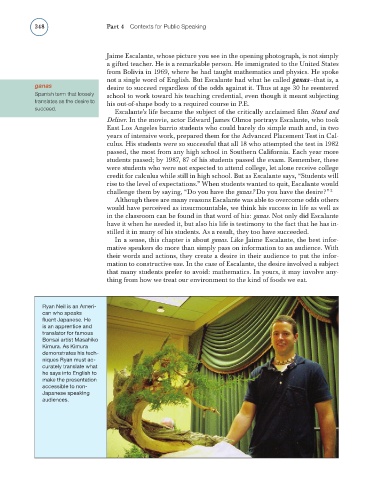
                    Ryan Neil is an Ameri-
                    can who speaks
                    fl uent Japanese. He
                    is an apprentice and
                    translator for famous
                    Bonsai artist Masahiko
                    Kimura. As Kimura
                    demonstrates his tech-
                    niques Ryan must ac-
                    curately translate what
                    he says into English to
                    make the presentation
                    accessible to non-
                    Japanese speaking
                    audiences.

