


Page 419 - Between One and Many The Art and Science of Public Speaking
P. 419
386                   Part 4  Contexts for Public Speaking


                                        emotionally charged appeals to make their case. Audiences can also let their
                                        emotions get in the way of their powers of reasoning.
                                          Yet emotion is not always outside the bounds of legitimate persuasive dis-
                                        course. In spite of his emphasis on rationality, for example, Aristotle recognized
                                        the role of emotions in the process of persuasion. He reasoned what modern re-
                                        searchers have demonstrated again and again: People are persuaded not simply
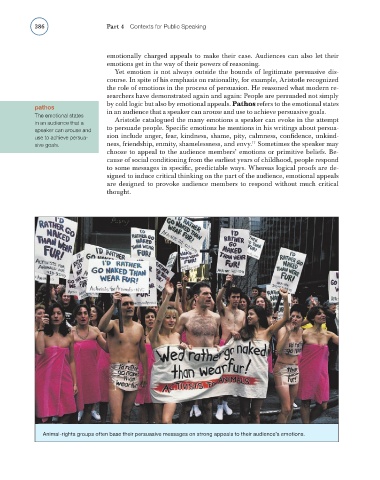
                                        by cold logic but also by emotional appeals. Pathos refers to the emotional states
                  pathos
                                        in an audience that a speaker can arouse and use to achieve persuasive goals.
                  The emotional states
                                          Aristotle catalogued the many emotions a speaker can evoke in the attempt
                  in an audience that a
                                        to persuade people. Specific emotions he mentions in his writings about persua-

                  speaker can arouse and
                  use to achieve persua-  sion include anger, fear, kindness, shame, pity, calmness, confi dence, unkind-
                                                                                   11
                  sive goals.           ness, friendship, enmity, shamelessness, and envy.  Sometimes the speaker may
                                        choose to appeal to the audience members’ emotions or primitive beliefs. Be-
                                        cause of social conditioning from the earliest years of childhood, people respond
                                        to some messages in specifi c, predictable ways. Whereas logical proofs are de-
                                        signed to induce critical thinking on the part of the audience, emotional appeals
                                        are designed to provoke audience members to respond without much critical
                                        thought.


                     Animal-rights groups often base their persuasive messages on strong appeals to their audience’s emotions.

