


Page 420 - Between One and Many The Art and Science of Public Speaking
P. 420
Chapter 14  Persuasive Speaking                387


                      Emotional appeals are not inherently unethical, but they can be abused by
                    unscrupulous persuaders. Nowhere is this more evident than in the case of the
                    most commonly used emotional appeal: fear.

                    Motivating Through Fear


                    Common sense tells us that we sometimes do things as a result of fear; for ex-
                    ample, we obey the law because we are afraid of the penalties we could suf-
                    fer should we break it. Yet the research suggests that when it comes to persua-
                    sive speaking, fear has its limits. Whether your goal is to encourage the use of
                    shoulder and lap belts while driving, demonstrate how fl ossing your teeth can
                    prevent gum disease, or convince people everyone needs a gun for self-protec-
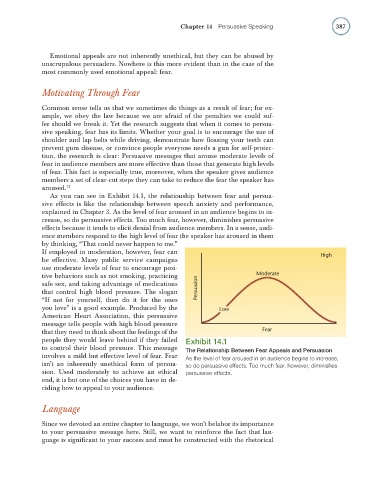
                    tion, the research is clear: Persuasive messages that arouse moderate levels of
                    fear in audience members are more effective than those that generate high levels
                    of fear. This fact is especially true, moreover, when the speaker gives audience
                    members a set of clear-cut steps they can take to reduce the fear the speaker has
                    aroused. 12
                      As you can see in Exhibit 14.1, the relationship between fear and persua-
                    sive effects is like the relationship between speech anxiety and performance,
                    explained in Chapter 3. As the level of fear aroused in an audience begins to in-
                    crease, so do persuasive effects. Too much fear, however, diminishes persuasive
                    effects because it tends to elicit denial from audience members. In a sense, audi-
                    ence members respond to the high level of fear the speaker has aroused in them
                    by thinking, “That could never happen to me.”
                    If employed in moderation, however, fear can
                                                                                                        High
                    be effective. Many public service campaigns
                    use moderate levels of fear to encourage posi-
                    tive behaviors such as not smoking, practicing                   Moderate
                    safe sex, and taking advantage of medications   Persuasion
                    that control high blood pressure. The slogan
                    “If not for yourself, then do it for the ones
                    you love” is a good example. Produced by the         Low
                    American Heart Association, this persuasive
                    message tells people with high blood pressure
                    that they need to think about the feelings of the                 Fear
                    people they would leave behind if they failed   Exhibit 14.1
                    to control their blood pressure. This message   The Relationship Between Fear Appeals and Persuasion
                    involves a mild but effective level of fear. Fear   As the level of fear aroused in an audience begins to increase,
                    isn’t an inherently unethical form of persua-  so do persuasive effects. Too much fear, however, diminishes
                    sion. Used moderately to achieve an ethical   persuasive effects.
                    end, it is but one of the choices you have in de-
                    ciding how to appeal to your audience.


                    Language

                    Since we devoted an entire chapter to language, we won’t belabor its importance
                    to your persuasive message here. Still, we want to reinforce the fact that lan-
                    guage is signifi cant to your success and must be constructed with the rhetorical

