


Page 423 - Between One and Many The Art and Science of Public Speaking
P. 423
390                   Part 4  Contexts for Public Speaking


                    Communicator            Audience               Route to Persuasion   Result
                    and Message
                                                                     Central route:          If argument is
                                                 Motivated
                                                and able to         Audience receives      accepted, audience
                                                understand.           and elaborates      undergoes long-term
                                                                       on message.          attitude change.

                        Persuasive
                         Speech
                                                                    Peripheral route:
                                               Audience finds         Audience uses          Audience can
                                              message irrelevant,     peripheral cues     easily be persuaded
                                              or is unwilling or      and is affected         by other
                                             unable to understand.                          communication.
                                                                       by mood.


                  Exhibit 14.2
                  Two Routes to Persuasion in the Elaboration Likelihood Model


                                        and relevant, there is no guarantee that the audience will accept them. If a mes-
                                        sage is perceived as incompatible with what audience members already know or
                                        believe in, it is likely to be rejected. For example, a speech on nuclear terrorism
                                        that misstated well-known facts or proposed violating basic civil liberties would
                                        likely be unacceptable to many audience members, even if they understood it
                                        and saw its relevance.
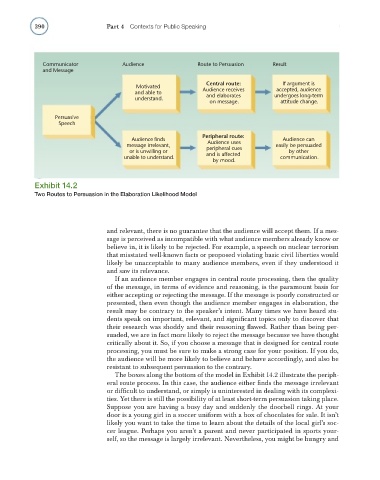
                                          If an audience member engages in central route processing, then the quality
                                        of the message, in terms of evidence and reasoning, is the paramount basis for
                                        either accepting or rejecting the message. If the message is poorly constructed or
                                        presented, then even though the audience member engages in elaboration, the
                                        result may be contrary to the speaker’s intent. Many times we have heard stu-
                                        dents speak on important, relevant, and signifi cant topics only to discover that
                                        their research was shoddy and their reasoning fl awed. Rather than being per-
                                        suaded, we are in fact more likely to reject the message because we have thought
                                        critically about it. So, if you choose a message that is designed for central route
                                        processing, you must be sure to make a strong case for your position. If you do,
                                        the audience will be more likely to believe and behave accordingly, and also be
                                        resistant to subsequent persuasion to the contrary.
                                          The boxes along the bottom of the model in Exhibit 14.2 illustrate the periph-
                                        eral route process. In this case, the audience either fi nds the message irrelevant
                                        or diffi cult to understand, or simply is uninterested in dealing with its complexi-
                                        ties. Yet there is still the possibility of at least short-term persuasion taking place.
                                        Suppose you are having a busy day and suddenly the doorbell rings. At your
                                        door is a young girl in a soccer uniform with a box of chocolates for sale. It isn’t
                                        likely you want to take the time to learn about the details of the local girl’s soc-
                                        cer league. Perhaps you aren’t a parent and never participated in sports your-
                                        self, so the message is largely irrelevant. Nevertheless, you might be hungry and

