


Page 351 - Beyond Decommissioning
P. 351
Case studies of nuclear redevelopment                             327


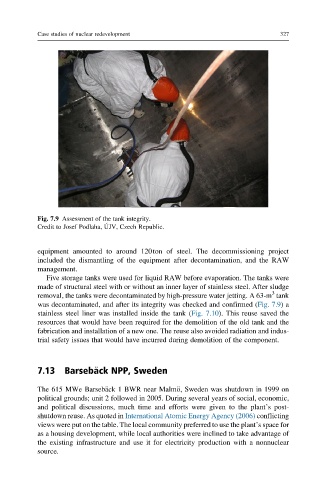
           Fig. 7.9 Assessment of the tank integrity.
                             ´
           Credit to Josef Podlaha, UJV, Czech Republic.

           equipment amounted to around 120ton of steel. The decommissioning project
           included the dismantling of the equipment after decontamination, and the RAW
           management.
              Five storage tanks were used for liquid RAW before evaporation. The tanks were
           made of structural steel with or without an inner layer of stainless steel. After sludge
                                                                          3
           removal, the tanks were decontaminated by high-pressure water jetting. A 63-m tank
           was decontaminated, and after its integrity was checked and confirmed (Fig. 7.9)a
           stainless steel liner was installed inside the tank (Fig. 7.10). This reuse saved the
           resources that would have been required for the demolition of the old tank and the
           fabrication and installation of a new one. The reuse also avoided radiation and indus-
           trial safety issues that would have incurred during demolition of the component.


           7.13   Barseb€ ack NPP, Sweden

           The 615 MWe Barseb€ ack 1 BWR near Malm€ o, Sweden was shutdown in 1999 on
           political grounds; unit 2 followed in 2005. During several years of social, economic,
           and political discussions, much time and efforts were given to the plant’s post-
           shutdown reuse. As quoted in International Atomic Energy Agency (2006) conflicting
           views were put on the table. The local community preferred to use the plant’s space for
           as a housing development, while local authorities were inclined to take advantage of
           the existing infrastructure and use it for electricity production with a nonnuclear
           source.

