


Page 352 - Beyond Decommissioning
P. 352
328                                                Beyond Decommissioning


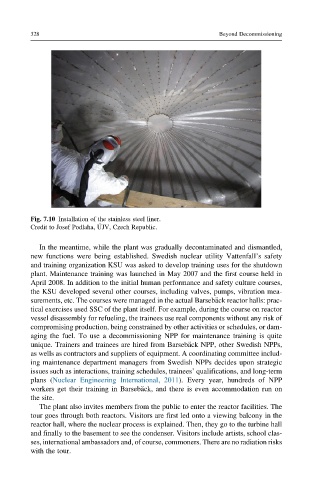
         Fig. 7.10 Installation of the stainless steel liner.
                            ´
         Credit to Josef Podlaha, UJV, Czech Republic.
            In the meantime, while the plant was gradually decontaminated and dismantled,
         new functions were being established. Swedish nuclear utility Vattenfall’s safety
         and training organization KSU was asked to develop training uses for the shutdown
         plant. Maintenance training was launched in May 2007 and the first course held in
         April 2008. In addition to the initial human performance and safety culture courses,
         the KSU developed several other courses, including valves, pumps, vibration mea-
         surements, etc. The courses were managed in the actual Barseb€ ack reactor halls: prac-
         tical exercises used SSC of the plant itself. For example, during the course on reactor
         vessel disassembly for refueling, the trainees use real components without any risk of
         compromising production, being constrained by other activities or schedules, or dam-
         aging the fuel. To use a decommissioning NPP for maintenance training is quite
         unique. Trainers and trainees are hired from Barseb€ ack NPP, other Swedish NPPs,
         as wells as contractors and suppliers of equipment. A coordinating committee includ-
         ing maintenance department managers from Swedish NPPs decides upon strategic
         issues such as interactions, training schedules, trainees’ qualifications, and long-term
         plans (Nuclear Engineering International, 2011). Every year, hundreds of NPP
         workers get their training in Barseb€ ack, and there is even accommodation run on
         the site.
            The plant also invites members from the public to enter the reactor facilities. The
         tour goes through both reactors. Visitors are first led onto a viewing balcony in the
         reactor hall, where the nuclear process is explained. Then, they go to the turbine hall
         and finally to the basement to see the condenser. Visitors include artists, school clas-
         ses, international ambassadors and, of course, commoners. There are no radiation risks
         with the tour.

