


Page 117 - Biobehavioral Resilence to Stress
P. 117
94                                 Biobehavioral Resilience to Stress


                                                              Normal
                                                     Physiological response
                                                       Stress


                                                         Activity
                                                                  Recovery
                                                               Time
                                                             Allostatic load


                                               Repeated "hits"           Lack of adaptation
                                         Physiological response


                                            Normal response repeated over time
                                                   Time                    Normal adaptation
                                                                              Time
                                              Prolonged response        Inadequate response
                                         Physiological response  No recovery


                                                    Time                       Time
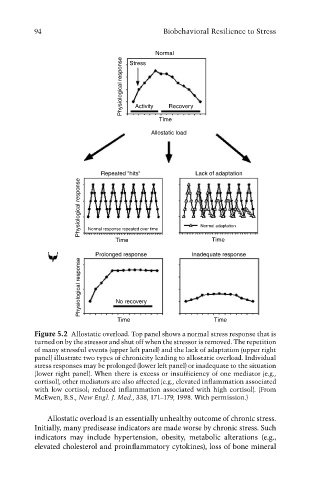
                             Figure 5.2  Allostatic overload. Top panel shows a normal stress response that is
                             turned on by the stressor and shut off when the stressor is removed. The repetition
                             of many stressful events (upper left panel) and the lack of adaptation (upper right
                             panel) illustrate two types of chronicity leading to allostatic overload. Individual
                             stress responses may be prolonged (lower left panel) or inadequate to the situation
                             (lower right panel). When there is excess or insufficiency of one mediator (e.g.,
                             cortisol), other mediators are also affected (e.g., elevated infl ammation associated

                             with low cortisol; reduced inflammation associated with high cortisol). (From
                             McEwen, B.S., New Engl. J. Med., 338, 171–179, 1998. With permission.)

                                Allostatic overload is an essentially unhealthy outcome of chronic stress.
                             Initially, many predisease indicators are made worse by chronic stress. Such
                             indicators may include hypertension, obesity, metabolic alterations (e.g.,

                             elevated cholesterol and proinflammatory cytokines), loss of bone mineral


                                                                                             12/17/2007   3:27:52 PM
                    CRC_71777_Ch005.indd   94
                    CRC_71777_Ch005.indd   94                                                12/17/2007   3:27:52 PM

