


Page 118 - Biobehavioral Resilence to Stress
P. 118
Adaptation to Stress                                             95

                             and muscle protein, shortening of telomeres and reduced telomerase activity,
                             memory impairment, and increased anxiety. Over longer periods of time,
                             overt disease becomes more likely. Certainly, individuals vary in their genetic
                             and psychological vulnerability to disease. It is not yet known precisely to
                             what extent chronic stress increases vulnerability to specific types of illness,


                             but the well-known multiple biochemical effects of stress make it reasonable

                             to consider the potentially broad effects of chronic stress on multiple body
                             systems and disease-related processes.


                             Stress and the Brain


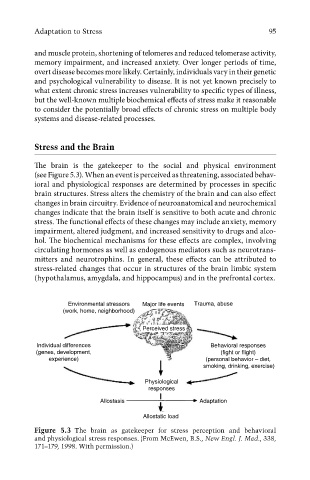
                             The brain is the gatekeeper to the social and physical environment
                             (see Figure 5.3). When an event is perceived as threatening, associated behav-
                             ioral and physiological responses are determined by processes in specifi c
                             brain structures. Stress alters the chemistry of the brain and can also eff ect
                             changes in brain circuitry. Evidence of neuroanatomical and neurochemical
                             changes indicate that the brain itself is sensitive to both acute and chronic

                             stress. The functional effects of these changes may include anxiety, memory

                             impairment, altered judgment, and increased sensitivity to drugs and alco-

                             hol. The biochemical mechanisms for these effects are complex, involving

                             circulating hormones as well as endogenous mediators such as neurotrans-
                             mitters and neurotrophins. In general, these effects can be attributed to

                             stress-related changes that occur in structures of the brain limbic system
                             (hypothalamus, amygdala, and hippocampus) and in the prefrontal cortex.

                                      Environmental stressors  Major life events  Trauma, abuse
                                     (work, home, neighborhood)

                                                           Perceived stress

                             Individual differences                           Behavioral responses
                             (genes, development,                               (fight or flight)
                                 experience)                                (personal behavior – diet,
                                                                            smoking, drinking, exercise)

                                                           Physiological
                                                            responses
                                               Allostasis                 Adaptation

                                                           Allostatic load
                             Figure 5.3  The brain as gatekeeper for stress perception and behavioral
                             and physiological stress responses. (From McEwen, B.S., New Engl. J. Med., 338,
                             171–179, 1998. With permission.)


                                                                                             12/17/2007   3:27:52 PM
                    CRC_71777_Ch005.indd   95
                    CRC_71777_Ch005.indd   95                                                12/17/2007   3:27:52 PM

