


Page 184 -
P. 184
Chapter 4  •  Business Reporting, Visual Analytics, and Business Performance Management   183

                    smaller rectangles representing sub-branches. A leaf node’s rectangle has an area pro-
                    portional to a specified dimension on the data. Often the leaf nodes are colored to
                    show a   separate dimension of the data. When the color and size dimensions are
                    correlated in  some way with the tree structure, one can often easily see patterns
                    that would be difficult to spot in other ways, such as if a certain color is particularly
                      relevant. A second advantage of tree maps is that, by construction, they make efficient
                    use of space. As a result, they can  legibly display thousands of items on the screen
                    simultaneously.
                        Even though these charts and graphs cover a major part of what is commonly used
                    in information visualization, they by no means cover it all. Nowadays, one can find many
                    other specialized graphs and charts that serve a specific purpose. Furthermore, current
                    trends are to combine/hybridize and animate these charts for better looking and more
                    intuitive  visualization  of  today’s  complex  and  volatile  data  sources.  For  instance,  the
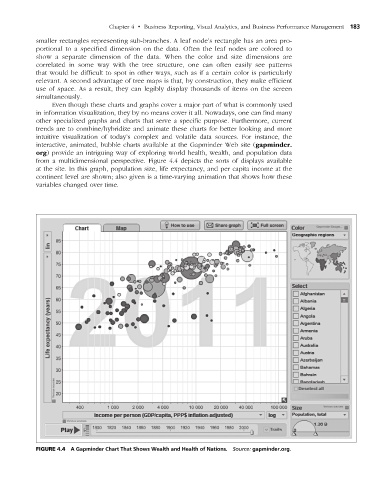
                      interactive, animated, bubble charts available at the Gapminder Web site (gapminder.
                    org) provide an intriguing way of exploring world health, wealth, and population data
                    from a multidimensional perspective. Figure 4.4 depicts the sorts of displays available
                    at the site. In this graph, population size, life expectancy, and per capita income at the
                    continent level are shown; also given is a time-varying animation that shows how these
                    variables changed over time.


                    figuRe 4.4  A Gapminder Chart That Shows Wealth and Health of Nations.  Source: gapminder.org.


           M04_SHAR9209_10_PIE_C04.indd   183                                                                     1/25/14   7:34 AM

