


Page 186 -
P. 186
Chapter 4  •  Business Reporting, Visual Analytics, and Business Performance Management   185

                                       Challengers          Leaders


                                                         Tableau Software  Microsoft
                                                                   QlikTech
                                                                     Oracle  IBM
                                                                      SAS
                                                                    MicroStrategy
                                    Ability to execute  Board International  Actuate  SAP
                                                                  Tibco Spotfire
                                               LogiXML
                                                              Information Builders
                                                   Birst
                                           Prognoz
                                            Bifam
                                                           Panorama Software
                                                      Alterys
                                         Jaspersoft  Salient Management Company
                                            Pentaho
                                           Targit    GoodData
                                           Arcplan


                                       Niche players        Visionaries
                                                   Completeness of vision

                                                                  As of February 2013
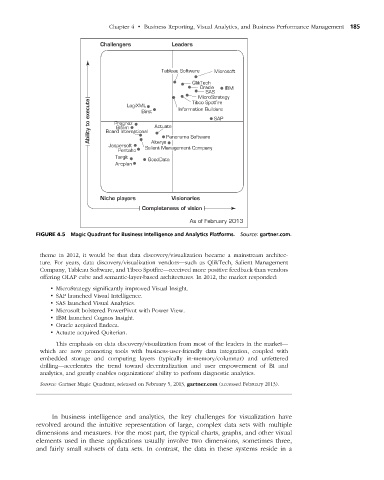
                    figuRe 4.5  Magic Quadrant for Business Intelligence and Analytics Platforms.  Source: gartner.com.


                     theme in 2012, it would be that data discovery/visualization became a mainstream architec-
                     ture. For years, data discovery/visualization vendors—such as QlikTech, Salient Management
                     Company, Tableau Software, and Tibco Spotfire—received more positive feedback than vendors
                     offering OLAP cube and semantic-layer-based architectures. In 2012, the market responded:
                        • MicroStrategy significantly improved Visual Insight.
                        • SAP launched Visual Intelligence.
                        • SAS launched Visual Analytics.
                        • Microsoft bolstered PowerPivot with Power View.
                        • IBM launched Cognos Insight.
                        • Oracle acquired Endeca.
                        • Actuate acquired Quiterian.
                          This emphasis on data discovery/visualization from most of the leaders in the  market—
                     which are now promoting tools with business-user-friendly data integration, coupled with
                     embedded storage and computing layers (typically in-memory/columnar) and unfettered
                       drilling—accelerates the trend toward decentralization and  user empowerment of  BI and
                       analytics, and greatly enables organizations’ ability to perform diagnostic analytics.
                     Source: Gartner Magic Quadrant, released on February 5, 2013, gartner.com (accessed February 2013).


                        In business intelligence and analytics, the key challenges for visualization have
                    revolved around the intuitive representation of large, complex data sets with multiple
                    dimensions and measures. For the most part, the typical charts, graphs, and other visual
                    elements used in these applications usually involve two dimensions, sometimes three,
                    and fairly small subsets of data sets. In contrast, the data in these systems reside in a


           M04_SHAR9209_10_PIE_C04.indd   185                                                                     1/25/14   7:34 AM

