


Page 244 - Calculus Demystified
P. 244
CHAPTER 8
                                      Applications of the Integral
                                                                                                 231
                                                 243    2 · 243     0   0
                                        = 2π ·       −          −    −
                                                  2       5         2   5
                                               243
                                        = 2π ·
                                               10
                                          243π
                                        =      .
                                            5
                     You Try It: Use the method of cylindrical shells to calculate the volume enclosed
                     when the region 0 ≤ y ≤ sin x,0 ≤ x ≤ π/2, is rotated about the y-axis.


                     8.2.3 DIFFERENT AXES
                     Sometimes it is convenient to rotate a curve about some line other than the
                     coordinate axes. We now provide a couple of examples of that type of problem.

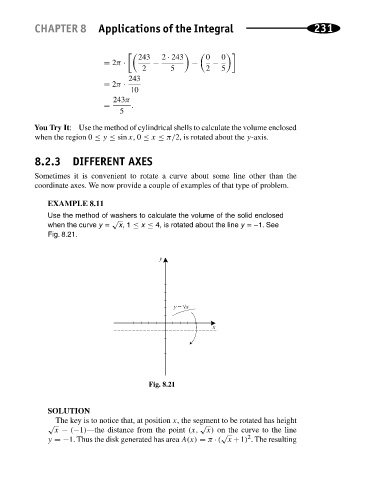
                         EXAMPLE 8.11
                         Use the method of washers to calculate the volume of the solid enclosed
                                          √
                         when the curve y =  x,1 ≤ x ≤ 4, isrotated about the line y =−1. See
                         Fig. 8.21.


                                                       y


                                                           y = √x

                                                                     x


                                                    Fig. 8.21


                         SOLUTION
                           The key is to notice that, at position x, the segment to be rotated has height
                         √                                        √
                           x − (−1)—the distance from the point (x,  x) on the curve to the line
                                                                        √
                                                                               2
                         y =−1. Thus the disk generated has area A(x) = π ·( x +1) . The resulting

