


Page 122 - Calculus Workbook For Dummies
P. 122
106       Part III: Differentiation


                The Mean Value Theorem:

                Go Ahead, Make My Day


                          The Mean Value Theorem is based on an incredibly simple idea. Say you go for a one
                          hour drive and travel 50 miles. Your average speed, of course, would be 50 mph. The
                          Mean Value Theorem says that there must be at least one point during your trip when
                          your speed was exactly 50 mph. But you don’t need a fancy-pants calculus theorem to
                          tell you that. It’s just common sense. If you went slower than 50 mph the whole way,
                          you couldn’t average 50. And if you went faster than 50 the whole way (this assumes
                          you’re going faster than 50 at your starting point), your average speed would be
                          greater than 50. The only way to average 50 is to go exactly 50 the whole way or to
                          go slower than 50 some times and faster than 50 at other times. And when you speed
                          up or slow down, you have to pass exactly 50 at some point.

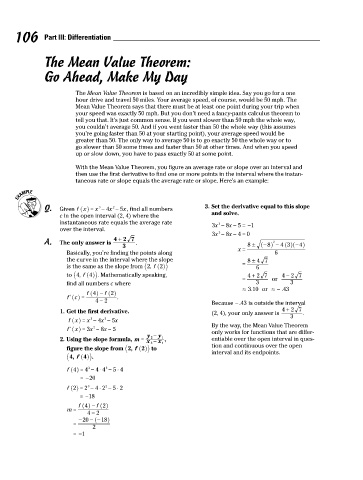
                          With the Mean Value Theorem, you figure an average rate or slope over an interval and
                          then use the first derivative to find one or more points in the interval where the instan-
                          taneous rate or slope equals the average rate or slope. Here’s an example:


                Q.   Given f x =  x -  4 x -  5 x, find all numbers  3. Set the derivative equal to this slope
                                 3
                                      2
                           ^ h
                     c in the open interval (2, 4) where the          and solve.
                     instantaneous rate equals the average rate       3 x -  8 x - = - 1
                                                                        2
                                                                               5
                     over the interval.
                                                                        2
                                                                      3 x -  8 x - =  0
                                                                               4
                A.   The only answer is   4 +  2 7  .                                     2
                                         3                                        8 ! ^ - 8 - ^h  4 3 - 4h
                                                                                                 ^ h
                       Basically, you’re finding the points along              x =         6
                       the curve in the interval where the slope                  8 !  4 7
                       is the same as the slope from  , f2  2 ^ hj              =    6
                                                `
                       to  4 , f 4 ^ hj. Mathematically speaking,                 4 +  2 7   4 -  2 7
                         `
                                                                                =         or
                       find all numbers c where                                      3          3
                                                                                .  . 3 10 or . -  .43
                              ^
                             f 4 - ^h  f 2h
                         c =
                       f l ^ h         .
                                4 -  2
                                                                      Because  .43-  is outside the interval
                     1. Get the first derivative.                     (2, 4), your only answer is   4 +  2 7  .
                               3
                                   2
                       f x =  x -  4 x -  5 x                                                   3
                         ^ h
                                                                      By the way, the Mean Value Theorem
                                2
                          x =
                       f l ^ h  3 x -  8 x -  5                       only works for functions that are differ-
                                                 y 2 -  y 1
                     2. Using the slope formula, m =  x 2 -  x 1  ,   entiable over the open interval in ques-
                       figure the slope from  , f2  2 ^ hj to         tion and continuous over the open
                                          `
                                                                      interval and its endpoints.
                       ` 4 , f 4hj.
                           ^
                              3
                       f 4 =  4 -  4 4 $  2 -  5 4 $
                        ^ h
                           = - 20
                              3
                       f 2 =  2 - $  2  5 2
                                4 2 - $
                        ^ h
                           = - 18
                            ^
                           f 4 - ^h  f 2h
                       m =
                              4 -  2
                           - 20 - - 18h
                                ^
                         =
                               2
                         = - 1

