


Page 124 - Calculus Workbook For Dummies
P. 124
108       Part III: Differentiation


              Solutions for Derivatives and Shapes of Curves


                                                                             / 2 3
                    a Use the first derivative to find the local extrema of f x =  6 x -  4 x +  1. Local min at (0, 1);
                                                                      ^ h
                         local max at (1, 3).
                         1. Find the first derivative using the power rule.
                                     / 2 3
                             f x =  6 x -  4 x +  1
                              ^ h
                               x =
                            f l ^ h  4 x  -  / 1 3  -  4
                         2. Find the critical numbers of f.
                           a. Set the derivative equal to zero and solve.
                             4 x  -  / 1 3 -  4 =  0
                                 x  -  / 1 3 =  1
                                   x =  1
                                                                                               4
                                                                                  x =
                           b. Determine the x-values where the derivative is undefined: f l ^ h  4 x  -  / 1 3  -  4 =  -  4
                                                                                                x
                                                                                               3
                           Because the denominator is not allowed to equal zero, f l ^ h is undefined at x = 0. Thus the
                                                                             x
                           critical numbers of f are 0 and 1.
                         3. Plot the critical numbers on a number line.
                           I’m going to skip the figure this time because I assume you can imagine a number line with
                           dots at 0 and 1. Don’t disappoint me!
                         4. Plug a number from each of the three regions into the derivative.
                                        -  / 1 3
                                                 4
                                1 = ^
                            f l ^ - h  4 - 1h  -  4 = - -  4  = - 8
                                        -  / 1 3
                                1     1             / 1 3
                             f l c m  =  4 c m  -  4 = ^  -  4 =  positive
                                               4 2h
                                2     2
                                        -  / 1 3
                                               2
                             f l ^ 8 = ^h  4 8h  -  4 = -  4  = - 2
                         Note, again, how the numbers I picked for the first and third computations made the math easy.
                         With the second computation, you can save a little time and skip the final calculation because
                         all you care about is whether the result is positive or negative — this assumes that you know
                         that the cube root of 2 is more than 1 (you better!).
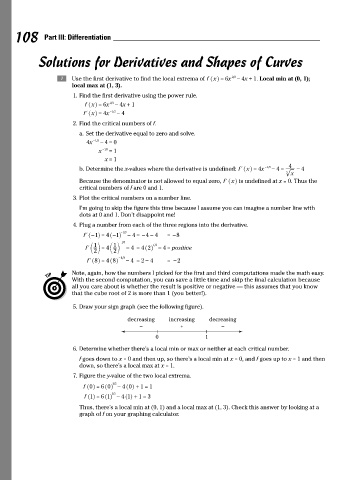
                         5. Draw your sign graph (see the following figure).
                                           decreasing   increasing   decreasing
                                               –            +            –
                                                    0               1

                         6. Determine whether there’s a local min or max or neither at each critical number.
                           f goes down to x = 0 and then up, so there’s a local min at x = 0, and f goes up to x = 1 and then
                           down, so there’s a local max at x = 1.
                         7. Figure the y-value of the two local extrema.
                                      / 2 3
                                         4 0 + =
                             ^
                            f 0 = ^h  6 0h  - ^ h  1  1
                                      / 2 3
                                         4 1 + =
                             f 1 = ^h  6 1h  - ^ h  1  3
                              ^
                           Thus, there’s a local min at (0, 1) and a local max at (1, 3). Check this answer by looking at a
                           graph of f on your graphing calculator.

